


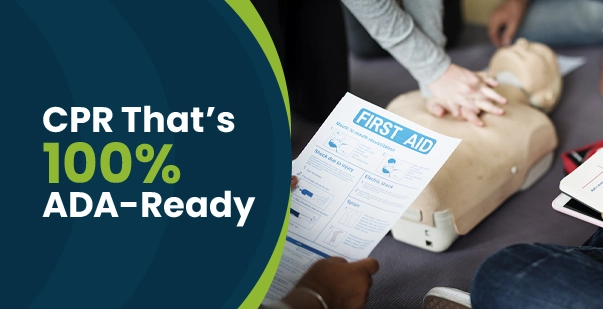
You are organizing first-aid training for your community center and realize something’s missing: one of your volunteers uses a wheelchair, and another has hearing problems. You need a course that doesn’t just teach cardiopulmonary resuscitation (CPR) and First Aid, but respects every ability in the room.
When training is designed with accessibility in mind, everyone has the chance to contribute, respond, and potentially save a life. This isn’t a rare consideration; according to the CDC (2025), over 61 million adults in the U.S. live with a disability. That’s one in four adults who may face barriers in learning these life-saving skills if accessibility isn’t prioritized. Inclusive trainings are designed with accessible materials, adaptable instruction, and delivery methods that work for all learners.
Under the Americans with Disabilities Act (ADA), training providers are required to ensure equal access for participants with disabilities. Yet many programs still fail to address the importance of physical, sensory, and cognitive needs, especially in the growing world of online courses. Read on to learn why inclusive CPR and first aid training matters, what ADA-compliant CPR training features to look for, and how providers can create environments where every learner can participate and practice.
What Prevents the Specially Abled from Accessing First Aid Training?
If you’re someone with a disability, you may have run into some frustrating blocks when trying to join or finish a first aid course. These problems can show up in different ways or even in how the program is set up. Let’s walk through what these challenges are that people face while taking both in-person and online training:
| Barrier Type | Offline Training | Online Training |
| Physical | Inaccessible venues (stairs, narrow doors, no elevators) | Incompatible with screen readers, keyboard-only navigation |
| Sensory | No Braille, unclear instructions, poor lighting/sound | No captions/transcripts, not compatible with vision/hearing aids |
| Cognitive and Learning | Fast-paced delivery, complex language, no visual reinforcement | Overloaded screens, poor navigation, inconsistent layout |
| Organizational | Fixed schedules, travel dependence | No session replays, lack of playback control, and rigid exam formats |
Read More: CPR and First Aid in Coastal Work Environments: A Must-Have Skillset
How Can First Aid Training Be Made Physically Accessible?
Around 12.2% of U.S. adults have serious difficulty walking or climbing stairs, according to CDC data. If venues are chosen without considering mobility needs, or if training tools require movements that not everyone can perform, many learners are effectively excluded. Here’s how you can offer ADA accessibility training and help every learner stay involved from start to finish:
Choose Venues and Interfaces That Support Mobility and Comfort
When you’re planning a training session—online or in person—make sure accessibility is part of the plan from the start. Use the checklist below to help you choose spaces and platforms that work for everyone.
In-Person Training:
ADA compliance must go beyond checking a box. Ensure your training space includes:
- Ramps with a 1:12 slope for easy access.
- Wide hallways, doorways, and clear pathways.
- Restrooms that accommodate various assistive devices.
- Seating arrangements that allow wheelchair users and service animals to integrate comfortably, not sit apart.
Online Training:
Digital learning environments should also support accessibility through:
- Navigation options like keyboard shortcuts, voice control, or screen readers.
- High contrast visuals and scalable text sizes.
- Interactive features that work without precise mouse movements (e.g., no drag-and-drop only).
Use Adaptive Tools for Hands-On Learning
In-Person Training:
Make hands-on learning inclusive with tools and techniques such as:
- One-handed CPR manikins and adjustable-height practice stations.
- AEDs with large buttons, tactile labels, or audio instructions.
- Instructors demonstrate from a seated or alternate position when needed.
Online Training:
Virtual tools must accommodate diverse physical needs. Prioritize:
- Simulations operable via keyboard or voice input.
- Alternatives to mouse-only interactions (avoid drag-and-drop where possible).
- Training modules that don’t assume fine motor control.
Support Rest and Movement Without Penalty
In-Person Training:
Help learners manage physical strain and energy levels with:
- Scheduled rest breaks during long sessions.
- Chairs with ergonomic or back-supportive options.
- Freedom to stand, move, or reposition without drawing attention or losing participation credit.
Online Training:
Build in flexibility for learners who need it most by offering:
- Pause/resume functionality to accommodate rest or a busy schedule.
- Saveable progress so learners don’t have to start over.
- Downloadable content for offline study.
Inclusion Tip:
Flexibility isn’t a perk, it’s a necessity. When learners can train on their terms, both completion rates and confidence levels rise.
How to Make Training Visually and Audibly Accessible by Default?
Roughly 6 million Americans are visually impaired, and a significant portion of U.S. adults report some form of hearing difficulty. Yet many first aid courses, both in-person and online, are not equipped to meet these learners where they are. Here’s how they can be more inclusive:
Provide Accessible Materials and Tools
In person, offer large-print manuals, Braille copies when needed, and tactile manikins that help with hand placement. Trainers should describe every action out loud rather than relying on visuals alone, and avoid phrases like “watch this” or “as you can see.” Here’s how you can do that:
Describe, Don’t Just Demonstrate:
When showing a technique, describe it step by step as you go. For example:
- Instead of silently demonstrating CPR, say:
“I’m now placing both hands in the center of the chest, one on top of the other, fingers interlocked.”
“I’m pushing straight down at a steady rhythm , about 100 to 120 compressions per minute.”
Pro Tips for Clear Descriptions:
- Use specific, concise language (“at the base of the sternum” instead of “here”)
- Give directional cues (“to your left,” “toward the feet,” “on the upper right side of the chest”)
- Name equipment and parts out loud (“I’m picking up the AED pads and removing the backing”)
- Pause to check for understanding or questions before continuing
In online formats, all visuals should have alt-text, all charts should be described in detail, and all buttons and menus must work with screen readers. Use high contrast text and backgrounds in colors that are clearly distinguishable from each other, and make sure that audio descriptions are available for every major demonstration. Web accessibility standards (like WCAG 2.1) recommend a contrast ratio of at least 4.5:1 for normal text, and 3:1 for large text.
Support With Captions and Interpreters
In a classroom, this could mean having a sign language interpreter, using real-time captioning, or giving written outlines of what will be said. Instructors should ensure that they follow the tips below:
- Face the class while speaking
- Don’t talk with your back turned
- Avoid chewing gum or covering your mouth, as it blocks lip reading
- Keep your face well-lit and unobstructed
In online mode, every video should have closed captions, and not just autogenerated ones. They should be accurate, manually edited, and synced. Offer transcripts of each lesson and provide visual handouts that match the verbal instructions, so learners who rely on reading can follow easily.
Read More: How Advanced CPR Training Tools Are Changing Education in 2025
How to Support Cognitive and Learning Differences?
Cognitive and learning disabilities are not always visible, but they’re common. The Learning Disabilities Association of America estimates that 1 in 5 children and adults in the U.S. have learning or attention issues. These learners often struggle with traditional teaching formats, especially those that use dense text, unclear structure, or time-limited tests. The following are the ways to make first aid training more inclusive:
Use Simple Language and Repeat Key Concepts
Whether you are teaching in person or online, avoid medical jargon or overly technical terms. Use plain English, and explain each step in small chunks. Repeat key instructions throughout the course: Don’t assume learners got it the first time.
Example – Technical to Simple:
- Technical: “Apply the AED pads to the upper right pectoral and lower left lateral thoracic region.”
- Simple: “Place one pad on the upper right side of the chest, and the other on the lower left side, just below the ribs.”
Online courses should avoid overwhelming users with large blocks of text. Instead, use short videos or slideshows with voiceovers, simple instructions, and clear visuals. Always give the learner control, allow them to replay lessons, slow things down, or move at their own pace.
Make Assessments Flexible and Low-Stress
Instead of relying on multiple-choice quizzes, in-person trainers can evaluate learners through hands-on demonstrations, verbal Q&A, or even simple walkthroughs of what they’d do in a scenario. For example, rather than asking, “What’s the compression-to-breath ratio?” on a test, ask the learner to show or explain how they would perform CPR on an adult; this checks both understanding and confidence without the stress of a test.
For online courses, assessments should allow multiple attempts, and progress should not be erased after a wrong answer. Offer options for written, video, or recorded responses, and make sure questions are clearly worded and free of tricky language.
Create Environments That Reduce Overload
Keep classroom settings quiet, clutter-free, and predictable. Loud background noise, flashing screens, or chaotic instructions all make learning harder for people with sensory sensitivities.
Online platforms should do the same: no auto-playing videos, no overwhelming color palettes, and no bouncing icons or graphics. Keep it clean, clear, and calm. That helps all learners, not just those with diagnosed conditions.
How to Accommodate Medical Needs in First Aid Training?
Evidence from adapted physical education and inclusive classrooms shows improved social-emotional well‑being, communication skills, and empowerment for people with disabilities. Disability-inclusive safety training ensures they are not left behind. For asthma, epilepsy, or autoimmune disorders, training programs must adapt without compromising safety or standards.
Gather Medical Details Before Training Starts
For both in-person and online courses, training providers should include a pre-course questionnaire that asks participants about chronic conditions like asthma, epileptic seizures, diabetes, or autoimmune disorders. This allows instructors to adjust the course format, equipment, or environment to prevent medical complications during training. It’s not about singling learners out. It’s about respecting their safety.
In online formats, a digital intake form can accomplish the same purpose. Including this step as part of the course registration process ensures learners won’t be put at risk during practical assessments or simulations.
Allow Rest Breaks Without Penalties
Fatigue is real and common for people managing chronic conditions like Cardiovascular Disease. For in-person sessions, this means clearly scheduled breaks and options for participants to pause if needed. Instructors must ensure that learners who take breaks aren’t excluded from certification or marked as incomplete.
Online courses must allow learners to pause, rewind, or resume modules at any time. The ability to save progress, download materials, or access content offline helps those who need to learn in shorter intervals due to pain, fatigue, or focus limitations.
What Should Trainers Do to Create Inclusive Programs?
Inclusion in CPR and safety training is of the utmost importance for legal compliance, equitable access, and real-world readiness. Let’s explore how trainers, organizations, and platforms can implement inclusive practices, from curriculum design to assistive technology:
1. Train Your Trainers for Accessibility and Inclusion
Instructors are the first point of contact in any training program. Their awareness and adaptability directly influence learner outcomes.
- Disability etiquette: Train staff in respectful, non-patronizing communication. Avoid assumptions about what learners can or cannot do.
- ADA compliance training: Ensure all instructors are familiar with Titles II and III of the Americans with Disabilities Act, which require public entities and private businesses to provide equal access to services, and understand how to fulfill accommodation obligations such as providing assistive technologies, modified materials, or alternative communication methods.
- Inclusive instruction methods: Use multiple teaching modes, visual, auditory, and kinesthetic, to address diverse learning needs. Offer slower pacing and repeat instruction when needed.
2. Build an Inclusive Curriculum That Reflects All Learners
An inclusive curriculum should represent disabled learners in both content and practice, not as exceptions, but as part of standard scenarios:
- Case studies with disabled responders: Include realistic scenarios that involve wheelchair users, visually impaired learners, or amputees in emergency roles. These examples should be respectful and based on real experiences, showing both their strengths and the challenges they may face. This helps avoid surface-level representation (tokenism) and encourages genuine inclusion.
- Modified drills: Adapt CPR practices using seated compressions or support tools for learners with physical impairments.
- Inclusive visuals: Use course imagery and examples that reflect people with a range of physical and cognitive abilities.
3. Use Accessible Feedback Mechanisms
Inclusive training doesn’t end with instruction; it also includes how learners give input.
- Paper Or Verbal Feedback Options: Provide large print, Braille, or spoken feedback sessions for those with reading or writing difficulties.
- Accommodated One-On-Ones: Allow feedback via scheduled verbal sessions for learners with speech or comprehension needs.
- Flexible Response Formats: Accept audio, text, or video responses to support different communication styles and limitations.
- Anonymous Feedback Channels: Offer anonymous surveys or digital forms to support learners who experience anxiety, cognitive overload, or discomfort with direct communication.
4. Use Tools That Support Inclusive Learning
Implementing the right tech tools ensures all learners can participate fully, whether the course is in-person, hybrid, or online:
| Tool Type | Recommended Tools | Description |
| Screen readers | JAWS, NVDA | Convert on-screen text to speech or Braille, helping users with visual impairments navigate digital content. |
| Voice-to-text | Otter.ai, Google Voice Typing | Transcribe spoken words into written text in real time, supporting users with mobility or learning differences. |
| LMS accessibility | SCORM-compliant, WCAG 2.1 Level AA (e.g., Moodle, Canvas) | Learning Management Systems (LMS) that follow accessibility standards ensure content works for all learners, including those using assistive technologies. |
These tools ensure that learners can access materials independently and interact with course content regardless of sensory limitations.
What Are the Best Practices for Inclusive First Aid Course Design?
If you’re offering first aid training for people with disabilities, the course design must reflect both usability and flexibility. Adopting universal design for learning helps ensure all learners can succeed. Here’s how you can do that:
Offer Blended and Online-First Formats
Accessibility begins with choice. When possible, learners should be able to choose between in-person, hybrid, or fully online formats. This flexibility supports people with a wide range of needs, not just those affected by physical location.
Learners with chronic conditions, mobility limitations, caregiving responsibilities, or demanding work schedules can participate in ways that align with their lives. For example, students in rural or remote areas can join without needing to travel. Offering multiple formats also reduces the need for travel, printed materials, and instructor hours.
Apply Universal Design for Learning (UDL) Principles
Universal Design for Learning (UDL) is an educational framework aimed at making learning accessible and effective for everyone, not just students with disabilities. The core idea is to design learning experiences that are flexible from the start, so they can meet the varied needs of all learners, whether those differences are in ability, language, attention span, motivation, or background knowledge. This makes courses more inclusive, practical, and enjoyable for a wider range of learners. The Three Core Principles of UDL are as follows:
- Multiple Means of Representation
People absorb and process information in different ways. UDL recommends presenting content through multiple formats to reach all learners.
- For example, you might combine visual aids, written instructions, audio narration, and demonstrations to explain the same concept.
- A CPR lesson, for instance, could include a short video showing the steps, a written checklist, and a diagram of hand placement on the chest.
- Multiple Means of Engagement
Learners stay motivated in different ways. UDL promotes giving students various ways to connect with the material, so they can stay interested and involved.
- Instructors might use role-play, problem-solving games, small group discussions, or scenario-based learning to keep learners engaged.
- In an online format, this could include interactive quizzes, discussion forums, or real-life case examples that make content feel relevant.
- Multiple Means of Action and Expression
Students should have different ways to show what they’ve learned. Not everyone excels at tests or written assignments.
- With UDL, learners might choose to complete a presentation, video demonstration, group project, or oral explanation instead of a traditional quiz.
- This is especially important in skill-based training like first aid or emergency response, where performance can be shown more effectively through hands-on demonstration than a written test.
Why UDL Matters
Applying UDL is not just about checking accessibility boxes. It’s about creating an environment where more learners feel seen, supported, and capable. It also improves outcomes across the board, not just for students with disabilities. When courses are flexible, engaging, and allow for varied input and expression, everyone benefits.
Make Scheduling and Format as Flexible as Content
Flexibility is key to equity. Many learners manage chronic conditions, shift work, or caregiving duties. Your course must adapt to their needs without compromising outcomes. Allow weekend sessions, evening classes, or one-on-one appointments for learners who can’t attend during standard hours. There should be no extra fees or penalties for rescheduling.
For learners who prefer online options, offer anytime access rather than fixed start dates. Courses must include pre-recorded modules that can be paused or replayed as needed. Avoid tight submission windows, especially for quizzes or skill check-ins. If live sessions are included, offer multiple time options or make recordings available.
How Can Learners Advocate for Their Own Accessibility Needs?
The ADA protects every learner’s right to equal access, but not every provider educates learners on how to use those rights. Therefore, if you are signing up for a certification course, inclusive workplace safety training, or a college program, you need to ask the right questions. Important questions include:
- Is your venue wheelchair accessible?
- Are captions and transcripts provided for all course videos?
- Do you offer materials in large print or audio?
- Can assessments be adapted if needed?
- Are emergency evacuation procedures accessible to people with mobility impairments?
- Are instructors trained in ADA accessibility and disability awareness?
- Is technical support available if I have trouble accessing online content?
Know Your Rights Under ADA and Local Policies
The ADA guarantees your right to reasonable accommodation in any training or educational program, whether a public organization, private business, or online platform offers it. If a course is not accessible to you, you have the right to request changes.
In digital learning environments, Section 508 of the Rehabilitation Act requires electronic content to be accessible to people with disabilities. If you encounter barriers, you can file a complaint with the Department of Justice or your local ADA center.
Inclusive First Aid Training Starts with Intentional Design
Creating inclusive first aid training isn’t just about meeting legal requirements; it’s about ensuring everyone, regardless of ability, has a fair chance to learn life-saving skills. From physical accommodations in training spaces to screen reader–friendly online platforms, accessibility must be built into every stage of course design and delivery. Inclusive tools, modified assessments, flexible scheduling, and trained instructors all contribute to a safer, more equitable learning environment for people with disabilities.
Ready to take the next step? Partner with a reputable organization that specializes in ADA-compliant CPR training, and ensure your courses are built for everyone who needs them.