



The American Heart Association released its 2025 CPR & ECC Guidelines on October 22, 2025, the first major overhaul since 2020. These updates tighten what to teach, how to practice, and how to measure success in real emergencies.
What Changed at a Glance
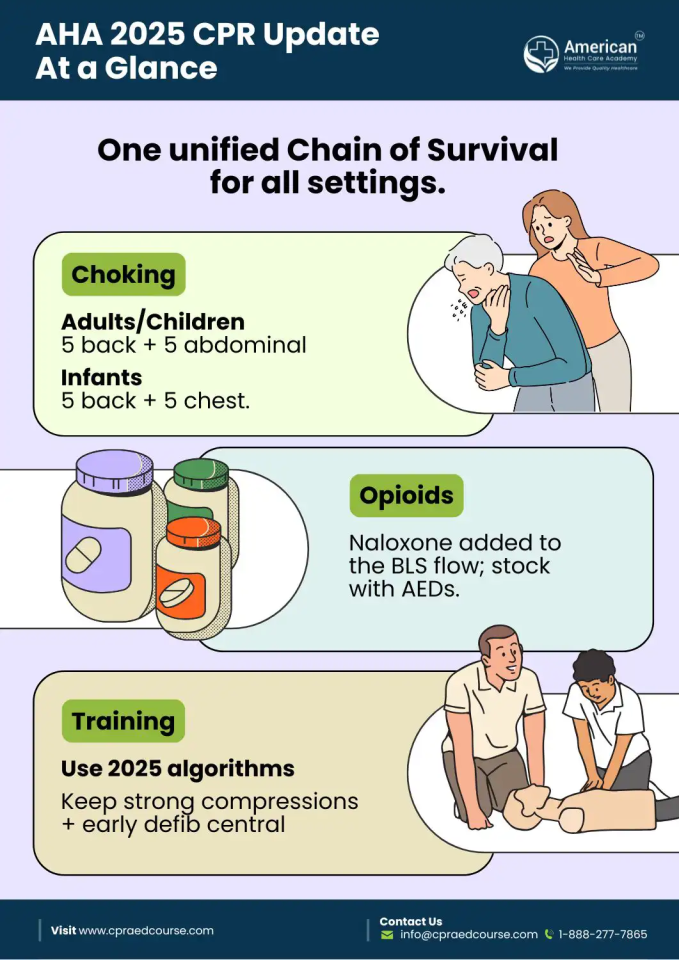
- One Chain of Survival: A single, unified Chain of Survival now covers adult and pediatric, in- and out-of-hospital cardiac arrest, so the message is consistent across settings.
- Choking update: As per AHA 2025 guidelines, for severe adult choking, the guidance calls for cycles of 5 back blows followed by 5 abdominal thrusts until the object comes out or the person becomes unresponsive.
- Opioid focus in BLS: The BLS algorithm explicitly shows where naloxone fits for suspected opioid overdose during respiratory and cardiac arrest.
- Courses refreshed: According to the AHA 2025 guidelines, it is updating course materials (videos, manuals, algorithms) across disciplines to reflect the new science.
- Context: The AHA’s press brief underscores new guidance on choking response, opioid emergencies, and the revised Chain of Survival.
Disclaimer: This summary is based on the American Heart Association’s 2025 CPR & ECC Guidelines. For complete and official recommendations, please refer to the AHA at cpr.heart.org. Note that updates could evolve through AHA errata or subsequent clarification memos.
Source: American Heart Association, 2025 CPR & ECC Guidelines, released October 22, 2025. Available at cpr.heart.org.
CPR / BLS: What this means for Learners and Employers
Training and testing should now reflect the updated BLS algorithm. Expect clearer visuals for lay rescuers, explicit naloxone placement, and the same core priorities—high-quality compressions and early defibrillation, presented in a cleaner, more teachable flow. For workplaces, update your skill checks, pocket cards, and emergency binders to align with the new algorithm so teams act the same way under stress.
Practical takeaways
- Align your in-service drills with the unified Chain of Survival so clinical and non-clinical staff speak the same language.
- For sites stocking naloxone, add when and how it’s given to BLS refreshers and post the step in break rooms or code carts.
- Update choking posters to the 5 back blows/5 abdominal thrusts cycle for adults.
ACLS: What Changed in Advanced Care
ACLS content is being refreshed to mirror the 2025 recommendations. Instructors will see updated videos, instructor manuals with tighter checklists, and a stronger push toward objective testing and documentation. For teams, the headline is consistency—roles, timing, defibrillation, airway, drugs—all taught against the same modern algorithm set.
What to do now
- Re-issue reference cards and update megacode scenarios to the 2025 flow.
- Confirm your competency tools (checklists, sims) match the new testing emphasis.
PALS: Pediatric Realities Built into the Curriculum
Most pediatric arrests start with respiratory failure or shock, not a primary cardiac cause. The 2025 guidance doubles down on early recognition, rapid support of breathing and circulation, and a system that gets kids to definitive care fast. Training should stress recognition skills, not just code-room mechanics.
What to do now
- Make sure your pediatric drills practice recognizing deterioration early (work of breathing, perfusion, mental status) and activating help before arrest.
- Tighten handoffs and escalation pathways which are now explicitly part of “doing PALS right.”
Heartsaver: Simpler for Real People in Real Moments
For community responders and workplace teams, the updates aim to be simpler to teach and easier to remember. Lay-rescuer visuals are streamlined; the adult choking sequence is clearer; and opioid-overdose steps are easier to find and follow. Expect course handouts and slide decks to reflect these exact changes.
Bottom line
The 2025 AHA update is about clarity and consistency: one Chain of Survival, a clearer adult choking sequence, and explicit opioid guidance backed by refreshed courses that make teaching and testing easier. Update your training now so your people act fast and act the same, whether they’re on a hospital floor, a clinic, or a factory line.
Disclaimer: This summary is provided for educational purposes and reflects highlights from the American Heart Association’s 2025 CPR & ECC Guidelines (released October 22, 2025). For complete and official recommendations, visit cpr.heart.org. [AHCA ] is an independent training provider and not affiliated with or endorsed by the American Heart Association.