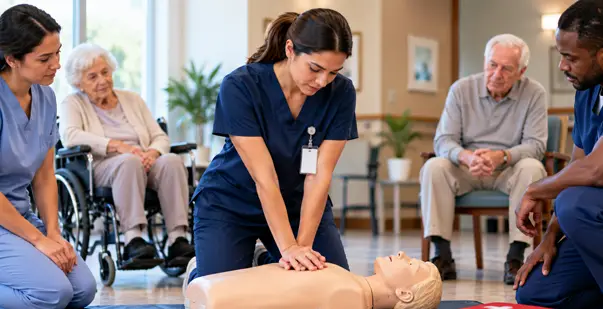



Basic life support (BLS) certification confirms that you are trained to respond when a life-threatening emergency happens in front of you. It prepares you to act quickly, follow a clear sequence of steps, and support a person until professional medical help arrives. Emergencies rarely announce themselves. A coworker collapses at work. A family member suddenly becomes unresponsive at home. In those first few minutes, there is often confusion, fear, and a lot of waiting. If you or your team are the first on scene, a valid BLS certification replaces hesitation with a structured plan that improves survival. This guide explains what BLS certification is, who needs it, why it matters, and the step-by-step process to get certified, so you know exactly what to expect and how to prepare.
Why Does BLS Matter?
Out-of-hospital cardiac arrest (OHCA) remains a major public health problem. According to the AHA 2024 Heart Disease and Stroke Statistical Update, about 356,000 people in the U.S. experience OHCA each year, and survival to hospital discharge is only around 9% for adults. The stats show the impact of immediate CPR and early defibrillation. Quick CPR and early defibrillation can double or even triple survival, especially when an AED is used within the first few minutes.
The AHA also issued 2024 focused updates and scientific statements refining resuscitation science and reporting standards, such as the latest drowning-related resuscitation guidance and updated Utstein reporting. These updates keep BLS training aligned with the latest evidence.
Who Should Get BLS Certification?
BLS is designed for healthcare professionals like nurses, physicians, respiratory therapists, EMS, dentists, technicians and first responders. It’s also appropriate for roles that may encounter medical emergencies, like athletic trainers or lifeguards, especially when employers require a provider-level course.
If you are not in a clinical role and only need CPR and AED training for general workplace compliance, an AHA Heartsaver course is often sufficient. To know which course you need, check your job posting, onboarding documents, or credentialing checklist, or ask your supervisor, HR department, or credentialing office directly. When in doubt, confirm the exact course name and issuing organization that your employer accepts before enrolling.
Read more: BLS Certification Lookup : Your Complete Guide
What You Learn in BLS (Core Competencies)
According to AHA, rescuers should aim for a chest-compression fraction (time spent compressing versus pausing) of >80%. The rate should be in the range of 100-120 compressions per minute and depth of at least 2 inches (5 cm) in adults. You get to learn all these key details in a BLS training. So, next time when you think about what a BLS certification is, recall the lifesaving skills you will learn discussed as follows:
1. High-Quality CPR for All Ages
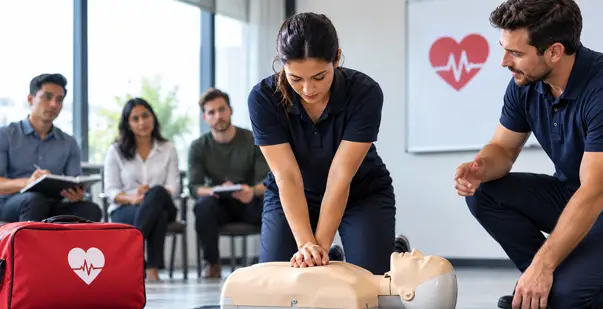
You learn how to perform CPR correctly for adults, children, and infants, with an emphasis on strong, consistent compressions and minimal pauses.
- Compress at 100-120/min.
- Push at least 2 inches deep in adults (about one-third chest depth in children and infants). Too shallow means the blood barely moves. Too deep increases the risk of injury without improving flow.
- Allow full chest recoil after each compression.
- Use the correct ratio: 30:2 for single rescuers (all ages) and 15:2 for two-rescuer infant or child CPR.
- Limit interruptions to keep blood flowing to the brain and heart.
2. AED Use and Defibrillation Safety
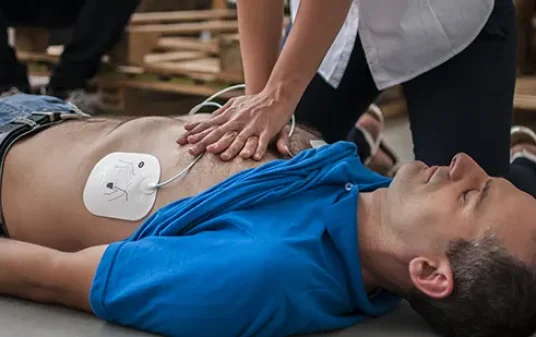
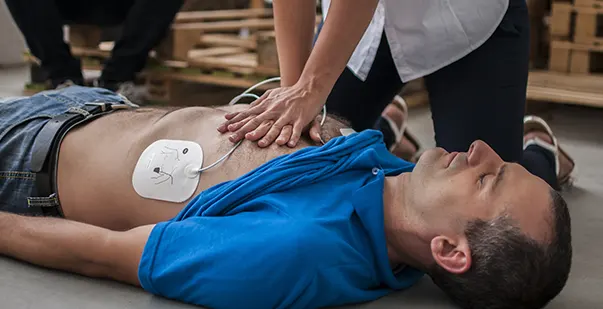
Automated External Defibrillators (AEDs) are devices designed to help restart an abnormal heart rhythm during cardiac arrest. In BLS, you learn how to:
- Turn on the AED and follow its voice prompts
- Place pads correctly on a bare, dry chest
- Clear everyone before a shock is delivered
- Resume compressions immediately after the shock
- Understand when a rhythm is shockable versus when CPR must continue
The focus stays on early defibrillation and fast action, not complex rhythm interpretation.
3. Effective Ventilation and Airway Support
BLS teaches how to support breathing safely when someone cannot breathe on their own.
- Use masks or bag-mask devices with a visible chest rise
- Avoid over-ventilating, which can reduce blood flow
- Open the airway correctly using head-tilt/chin-lift or jaw-thrust
- Adjust technique for infants and children, where breathing failure is more common
You also learn how to coordinate breaths with compressions when no advanced airway is present.
4. Choking Relief for Adults, Children, and Infants
You learn to recognize severe airway obstruction and respond quickly.
- Identify choking signs like inability to speak or weak coughing
- Use abdominal thrusts for adults and children
- Use chest thrusts for pregnant or obese individuals
- Deliver back slaps and chest thrusts for infants
- Avoid blind finger sweeps
- Transition smoothly to CPR if the person becomes unresponsive
5. Teamwork, Communication, and Leadership
BLS is not just about individual skills. It teaches how to function as a coordinated team during an emergency.
- Use clear, closed-loop communication
- Rotate compressors every two minutes to prevent fatigue
- Assign roles for compressions, airway, AED, and timing
- Keep pauses under 10 seconds
- Provide a clear handoff to EMS or advanced life support
Leadership matters. BLS training emphasizes that someone must take charge early, set the pace, assign roles, and keep the team focused on high-quality CPR until help arrives.
BLS vs. CPR vs. ACLS vs. PALS (Quick Guide)
Each level builds on the previous one, adding more advanced skills, deeper knowledge, and specialized focus. Choosing the right certification depends on your role, responsibilities, and the types of emergencies you’re most likely to face. Here’s a quick comparison to help you understand how BLS, CPR, ACLS, and PALS differ:
| Training | Who It’s For | Core Skills Covered | Key Focus | Validity | Typical Use Case |
| CPR (Layperson) | General public, teachers, parents, workplace responders | Chest compressions, AED use, basic choking relief | Immediate response before help arrives | 2 years | Home, school, workplace emergencies |
| BLS (Basic Life Support) | Healthcare professionals, first responders | High-quality CPR (adult/child/infant), AED use, ventilation, choking relief, team dynamics | Provider-level skills and coordination | 2 years | Hospitals, clinics, EMS, healthcare settings |
| ACLS (Advanced Cardiovascular Life Support) | Doctors, nurses, paramedics managing adult cardiac arrest | Advanced airway, medications, ECG rhythm interpretation, post-arrest care | Adult cardiac and respiratory emergencies | 2 years | Critical care units, emergency departments |
| PALS (Pediatric Advanced Life Support) | Pediatric clinicians, emergency teams | Pediatric airway management, rhythm recognition, medications, fluid therapy, post-resuscitation care | Infant and child emergencies | 2 years | Pediatric ICUs, emergency rooms, transport te |
Course Formats and What to Expect
BLS training is designed to fit different schedules and learning preferences. Whether you prefer the structure of a classroom or the flexibility of learning at your own pace, all formats lead to the same AHA-approved BLS certification. Here’s how the three main options compare:
| Format | What It Involves | Time Commitment | Typical Cost* | Best For | Key Highlights |
| In-Person Classroom | Traditional, instructor-led course with lectures, hands-on manikin practice, AED use, and a skills check. | ~4–4.5 hours | ~$85 | Learners who prefer face-to-face instruction | Direct feedback from instructors and real-time practice with peers. |
| Blended (Online + Hands-On) | Self-paced online learning followed by a short in-person skills session. (HeartCode BLS) | Online: ~1–2 hoursSkills: ~1–2 hours | ~$70–$120 | Busy professionals who want flexibility and efficiency | Most popular choice – same certification with less time commitment, more convenience, and full employer acceptance. |
| Fully Online | 100% virtual theory course with remote or simulated skills evaluation | <2 hours | ~$55–$85 | Those needing a quick refresh and whose employer accepts online credentials | Easiest and most affordable, though not always accepted for clinical ro |
Step-by-Step: How to Get BLS Certified
Every second matters in a cardiac emergency, yet fewer than 10% of adults survive out-of-hospital cardiac arrest in the U.S. BLS certification prepares you to act quickly and correctly when a life depends on it. The process today is flexible and straightforward. Here’s how to do it right:
1. Confirm the Right Course
Check your employer’s requirements first. Most healthcare roles accept AHA BLS Provider or Red Cross BLS for Healthcare Providers, not basic Heartsaver courses.
2. Choose the Right Format
You can train in person, through a blended format, or fully online. Blended learning is popular because it combines self-paced theory with a short in-person skills check.
3. Review the Basics Ahead of Time
Refresh CPR rates and depth, AED use, ventilation, and choking relief for all ages. A quick review of the AHA 2024 guidelines makes skills practice smoother.
4. Complete the Course and Skills Check
Complete the course online and practice realistic scenarios to demonstrate CPR, AED use, and ventilation. Most learners complete everything within 3 to 6 hours.
5. Receive Your eCard
After passing, you get a digital BLS card valid for two years. Save a PDF copy for easy employer verification.
6. Plan Renewal Early
Set a reminder 18–21 months after certification. Renewal courses are shorter and focus on maintaining high-quality skills.
Read more: 11 Reasons to Get Your BLS Certification Online
How BLS Fits Into the Chain of Survival?
BLS training supports multiple links in the Chain of Survival: early recognition and activation of EMS, immediate high-quality CPR, rapid defibrillation, and coordinated handoff to advanced care. Current AHA statistics and updates reinforce that early action is the biggest lever we control.
How Long is BLS Certification Valid?
BLS certification is usually valid for two years from the issue date. Most employers ask that you renew before it expires, since an active card is often required for scheduling or credentialing. Planning your renewal early, such s 30-60 days before the expiry, keeps things smooth and stress-free.
Take the Next Step and Get BLS Certified Today!
What is BLS certification? It’s your proof that you can deliver the right actions in the first critical minutes of a cardiac or breathing emergency, skills that change outcomes. With evidence-based updates in 2024 and beyond, BLS remains the base credential for clinicians and a smart upskill for prepared communities.
Start now. Enroll in an accredited online Healthcare CPR/AED & First Aid (BLS) Combo, learn at your own pace, and be the person who knows exactly what to do when it matters most.
FAQs
1. How long does BLS certification last?
Typically two years. Plan renewal before it expires to avoid a lapse at work.
2. Is BLS different from CPR?
Yes. CPR (public level) covers the basics; BLS is the provider-level course for healthcare and first responders, with deeper skills and team-based practice.
3. I’m a teacher/coach. Do I need BLS or Heartsaver?
Many schools accept Heartsaver CPR/AED for non-clinical staff. If your role includes clinical-type responsibilities (e.g., athletic trainers), your employer may require BLS. Always confirm locally.