


What Does CMS Require?
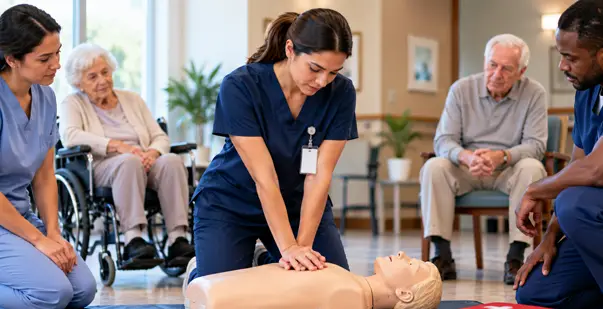
The requirement sits at 42 CFR 483.24(a)(3) and is surveyed under F-tag F678. In plain terms, a facility must ensure that personnel provide basic life support, including CPR, to a resident requiring emergency care prior to the arrival of emergency medical personnel. That obligation is subject to related physician orders and the resident’s advance directives.
Three things follow from that sentence, and surveyors check all three.
- Staff certified in CPR must be available at all times, which means every shift, including nights and weekends.
- Certification must be current. An expired card is the same as no card.
- A facility-wide policy of not performing CPR is prohibited, because it overrides the advance directives of residents who have chosen to be resuscitated.
That last point is worth stating plainly: a facility cannot decide as a matter of policy that it waits for EMS. A resident who has not declined resuscitation is entitled to receive it from the staff who are present.
Which Staff Need CPR Certification?
The regulation requires that certified staff be available at all times rather than naming job titles, which means the answer depends on how a facility schedules. In practice, facilities that come through surveys cleanly certify broadly rather than narrowly:
- Registered nurses and licensed practical nurses on every shift.
- Certified nursing assistants, who are usually the first staff member to reach a resident.
- Nursing supervisors, charge nurses and the director of nursing.
- Respiratory, rehabilitation and therapy staff who work with residents unsupervised.
Certifying only the licensed nurses is the common shortfall. If a CNA finds an unresponsive resident at 3am and has to go find someone certified, the facility has a response time problem that a surveyor will identify from the staffing schedule without needing an incident to look at.
What Level of Certification Is Required?
CMS requires current CPR certification without naming a single brand of course. The practical standard is healthcare provider level rather than lay rescuer level, because nursing home staff work with a population that has predictable cardiac and respiratory risk and because healthcare provider training covers two-rescuer technique, bag-mask ventilation and pulse checks that lay courses do not. CPR certification for healthcare providers is the appropriate level for nursing home clinical staff, and many state survey agencies and corporate compliance programs specify it directly. BLS certification is the same standard under the name most employers use in job postings.
Why Online-Only Certification Is Not Accepted
This is the detail that causes the most trouble, and it is the reason facilities fail this tag with a drawer full of certificates.
CMS surveyor guidance requires that CPR training include hands-on practice and an in-person skills assessment. A course delivered entirely online, with no physical demonstration, does not satisfy the requirement no matter how legitimate the provider or how official the certificate looks. State agencies state this bluntly. Washington’s long term care bulletin puts it in four words: online only certification is not allowed.
What is accepted is a blended pathway. A program may deliver the knowledge component online if it also requires an in-person demonstration or skills assessment to obtain or renew the certification. That is the structure to look for and the structure to document.
Before you buy, confirm one thing
Ask how the in-person skills assessment is handled. Some facilities run skills checks internally with a qualified staff instructor. Some arrange a local session. Either is fine. What is not fine is completing an online module, printing a card, and filing it with no skills demonstration behind it.
If your facility has no skills assessment arrangement in place, set that up first. The online coursework is the easy half.
American Healthcare Academy’s online CPR course for healthcare providers covers the knowledge component at the level nursing home staff need, at your own pace and on your own schedule, which removes the hardest part of scheduling training across three shifts. Pair it with your facility’s in-person skills check to meet the CMS standard in full.
How Often Does Certification Need Renewing?
CPR certification is valid for two years from the date of issue across all major providers. Because the regulation requires certified staff to be available at all times, a lapsed card is not a paperwork problem, it is a coverage problem on every shift that person works.
Track expiry dates centrally and start renewals 60 to 90 days out rather than in the expiring month. CPR renewal is shorter than initial certification, and staggering renewals across the year keeps a facility from discovering that eleven cards expire in the same week.
What Surveyors Look For
Documentation is where facilities with good practice still get cited. Keep the following current and retrievable on request:
- A copy of the current certification card for every certified employee, showing issue and expiry dates.
- Evidence of the in-person skills assessment behind each certification, not just the certificate.
- A staffing schedule that demonstrates certified coverage on every shift, including nights, weekends and holidays.
- A written CPR policy that honors individual advance directives and contains no facility-wide no-CPR provision.
- Documentation that advance directive status is recorded and accessible to staff at the point of care.
- Post-event review documentation for any resuscitation attempt.
The most common citations are straightforward: expired cards still in the active file, certificates with no skills assessment behind them, and a night shift with no certified staff member scheduled.
Train Your Whole Team on One Schedule
Online coursework lets staff complete the knowledge component across shifts without pulling anyone off the floor, and group pricing is available for facilities certifying a full team.
Get Your Team Survey Ready!
CPR compliance in a nursing home is not complicated, but it has one trap in it, and the trap catches facilities that did everything else right. Online coursework plus a documented in-person skills check is the combination that satisfies F678. Online coursework alone is not. Start with the healthcare provider CPR course for the knowledge component, confirm your skills assessment arrangement, and see CPR certification for nursing homes for facility group pricing.
FAQs
Six questions, each answered in one self-contained paragraph. These map directly to the conversational phrasing that triggers AI Overview on this topic.
1. Does CMS require nursing home staff to be CPR certified?
Yes. Under 42 CFR 483.24(a)(3), surveyed as F-tag F678, a facility must ensure that personnel provide basic life support, including CPR, to a resident requiring emergency care before emergency medical services arrive, subject to physician orders and the resident’s advance directives. CMS guidance requires that CPR certified staff be available at all times, which means coverage on every shift including nights and weekends. A facility-wide policy of not performing CPR is prohibited, because it would override the advance directives of residents who have chosen to be resuscitated.
2. Does online-only CPR certification meet CMS requirements?
No. CMS surveyor guidance requires CPR training that includes hands-on practice and an in-person skills assessment, and online-only certification is not sufficient. A program may deliver its knowledge component online provided it also requires an in-person demonstration or skills assessment to obtain or renew the certification. Several state survey agencies state this directly. Facilities are routinely cited despite holding certificates for every employee, because the certificates have no documented skills assessment behind them. Confirm how your skills check is arranged before purchasing any course.
3. Do CNAs need CPR certification in a nursing home?
In practice, yes, and most facilities certify them. The regulation requires that certified staff be available at all times rather than naming job titles, but certified nursing assistants are usually the first staff member to reach an unresponsive resident. A facility that certifies only licensed nurses often cannot demonstrate certified coverage on every shift, and surveyors identify that from the staffing schedule without needing an incident to review. Certifying CNAs alongside nurses is the straightforward way to meet the availability requirement on nights and weekends.
4. What level of CPR certification do nursing home staff need?
Healthcare provider level, which is also sold as BLS. CMS requires current CPR certification without naming a specific course, but the healthcare provider standard is the appropriate one for clinical staff working with a population that carries predictable cardiac and respiratory risk. It covers two-rescuer technique, bag-mask ventilation and pulse assessment, none of which appear in lay rescuer courses. Many state survey agencies and corporate compliance programs specify the healthcare provider level directly, so check your state requirement and your own policy before enrolling staff.
5. How often do nursing home staff need to renew CPR certification?
Every two years, which is the validity period across all major certifying providers. Because the regulation requires certified staff to be available at all times, an expired card is a coverage problem rather than a paperwork problem, and it affects every shift that employee works. Track expiry dates centrally and begin renewals sixty to ninety days ahead rather than in the month of expiry. Staggering renewal dates across the year prevents the common situation where a group of staff certified together all expire in the same week.
6. Can a nursing home have a no-CPR policy?
No. CMS guidance prohibits facility-wide policies that prevent staff from performing CPR, because such a policy overrides the individual advance directives of residents who have chosen to be resuscitated. Decisions about resuscitation belong to the resident, recorded through advance directives and physician orders, and applied individually. A facility must honor a resident’s choice to receive CPR, which means having certified staff present and able to begin resuscitation before emergency services arrive. Advance directive status must also be recorded and accessible to staff at the point of care.