



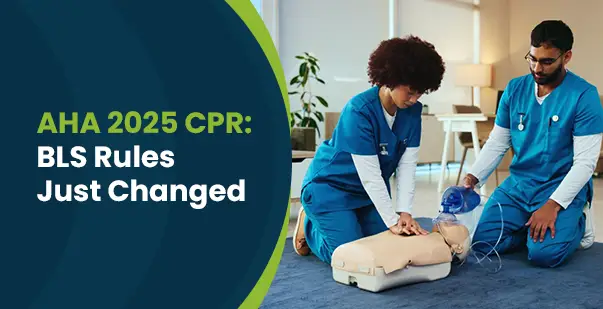
Every time the American Heart Association updates its guidelines, most people focus on the “headline changes”, compression depth, ventilation ratios, opioid response, and pediatric considerations. But the real shift in 2025 isn’t just the numbers. It’s how BLS learners are expected to think during a scenario. The new approach pushes responders to make quicker decisions, adapt faster to what they see, and rely less on memorized scripts. If you’re training or retraining this year, you’ll find the scenarios feel more real, more stressful, and far more focused on what happens in the first 60–90 seconds of an emergency. That’s where lives hinge.
More Real-Life Situations, Fewer “Perfect” Classroom Cases
The 2025 scenarios don’t treat CPR like a clean, calm checklist. Learners now face situations that look messy, fast-moving, and closer to what actually happens outside a textbook.
You’ll see:
- Victims in awkward positions
- Noisy environments
- Delayed bystanders
- Limited equipment
- Uncertain breathing or “barely breathing” presentations
These scenarios force learners to judge what’s happening instead of waiting for a cue.
Small example:
In earlier training, the instructor clearly announced “The victim is not breathing.”
Now, you often get: “The breaths seem strange, what will you do?”
Faster Recognition and Zero Delays
The biggest 2025 push is early action. BLS learners are trained to recognize cardiac arrest faster and move immediately.
Expect changes like:
- Shorter assessment windows
- Reduced hesitation around agonal breathing
- Compress-first mentality emphasized strongly
- Scenarios that punish delays with “victim deterioration”
Instructors now ask: “You checked too long, what do you do next?”
The point is simple: waiting kills. Quick decisions save brain time.
Greater Emphasis on Team Roles
Team-based scenarios are tougher. There’s more emphasis on knowing your role and switching roles smoothly.
Learners will practice:
- Calling out actions clearly
- Taking charge when others freeze
- Avoiding “crowding” around the victim
- Swapping compressors every two minutes without confusion
The new scenarios reward leadership, not silence. If you’re shy or tend to hang back, you’ll feel the difference immediately.
More Opioid-Linked Scenarios
The rise in opioid-related emergencies has reshaped BLS modules.
You’ll now find scenarios that include:
- Respiratory arrest with pulses
- Naloxone availability
- Victims progressing from unresponsiveness to cardiac arrest
- Guidance on when to use compressions vs when to ventilate
These aren’t niche add-ons, opioid emergencies are now mainstream in BLS training.
Pediatric Scenarios Feel More Realistic
Instead of “child lying neatly on the floor,” you might face:
- An infant slumped in a car seat
- A child who collapses during sports
- A choking emergency that escalates into cardiac arrest
You’ll be expected to adjust your approach on the spot, not rely on the old predictable sequence.
A key shift: pediatric depth and rhythm expectations have more clarity in 2025, so instructors use them more actively in testing.
Improved AED Integration
The AED is no longer introduced halfway through a scenario, it’s there almost immediately.
Expect scenarios where you must:
- Turn it on while still assessing
- Delegate AED tasks mid-compressions
- Troubleshoot odd pad placements
- Manage scenarios with only one rescuer but an available AED
Instead of “AED arrives later,” the new flow asks: “Why didn’t you ask for it sooner?”
Focus on Confusing, Grey-Area Situations
Real emergencies rarely look textbook-perfect. The 2025 updates finally acknowledge that.
Scenarios now include:
- Seizure-like movements
- Gasps mistaken for breathing
- Victims with medical devices
- Collapses in tight spaces
- Situations where bystanders give wrong information
This trains learners to trust skill over uncertainty.
Short example:
A bystander might say, “He’s breathing,” even when the victim clearly isn’t.
Learners must decide based on what they see, not what others claim.
Shorter, High-Intensity Drills
Instead of long, drawn-out scenarios, many 2025 drills are sharp, fast, and realistic. The goal is to test judgment and execution under pressure.
You’ll face:
- Quick-fire decision points
- No verbal hints
- More realistic time progression
- Stress-based learning (without overwhelming the learner)
It’s closer to how real emergencies unfold, fast, chaotic, unforgiving.
Conclusion
The 2025 CPR scenarios reshape how BLS learners approach emergencies, focusing more on quick recognition, confident action, and adaptability instead of memorized sequences. You’ll deal with messier environments, more realistic symptoms, and tighter time pressure. The goal is simple: build responders who can handle the uncertainty of real life. Whether you’re renewing or starting fresh, these new scenarios help you respond faster, think clearer, and make the kind of decisions that actually save lives.