




Choking is a serious emergency that requires quick action, but the good news is that it can often be managed if you know what to do. According to the National Safety Council, choking is the fourth leading cause of unintentional injury death. It claimed over 5,553 lives in the United States in 2022, with rates of death rising rapidly at about age 71. Children under age 5 are especially vulnerable: they account for the majority of nonfatal choking incidents and a large share of choking deaths. What’s important to remember is that it can happen at your home, in restaurants, or even during casual conversations over a meal. Therefore, everyone must have knowledge of choking first aid to help victims in emergencies. This guide will walk you through everything from prevention to step-by-step intervention, so you’re prepared when every second counts.
What Are the Types of Choking?
Before proceeding with providing CPR or first aid, you must know what type of choking the person is experiencing at the moment. The most common types of choking are as follows:
| Type of Choking | Key Signs | Recommended Action | Major Risks / Notes |
| Partial Obstruction |
|
|
|
| Complete Obstruction |
|
|
|
| Internal Obstruction / Swelling |
|
|
|
| External Airway Blockage |
|
|
|
Infant-Specific Note
Infants often choke silently with a weak cry, minimal coughing, or sudden loss of breathing.
- Give 5 back blows followed by 5 chest thrusts (not abdominal thrusts).
- Call 911 if the baby becomes unresponsive and begin infant CPR if trained.
What Not to Do
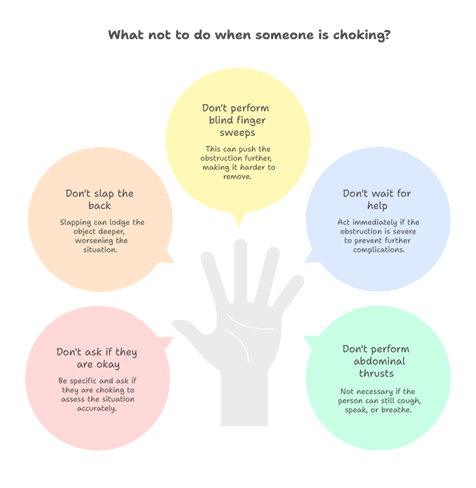
- Do not perform a blind finger sweep. It can push the object deeper.
- Do not slap the person’s back while they’re upright and still able to cough.
- Do not shake or reposition someone with a possible neck or spinal injury.
What Are the Causes of Choking?
Choking happens when something blocks the airway and prevents normal breathing. The causes can vary depending on age, health, and environment. Here are the main causes of choking:
| Category | Examples | At-Risk Groups | Prevention Tip |
| Food-Related | Large food chunks, tough meats, bread, peanut butter, nuts | Children, the elderly, and people with dental issues | Cut fruits like grapes into small pieces for toddlers and chew slowly before swallowing. |
| Non-Food Objects | Coins, small toys, marbles, buttons, batteries | Children (toddlers), individuals with habits like chewing objects | Keep small objects out of reach and supervise children closely. |
| Medical Conditions | Dysphagia (swallowing difficulty), neurological disorders (stroke, Parkinson’s), poorly fitting dentures | Elderly patients with neurological/medical issues | Seek medical evaluation and use swallowing aids or modified diets if required. |
| Behavioral | Eating too fast, laughing/talking while eating, running/playing while eating | Children, adults under alcohol/sedatives, distracted eaters | Encourage mindful eating in a calm, seated environment. |
Read More: Asphyxiation: Prevention, Causes, Symptoms & Treatment
Steps Before Giving Breaths to an Unresponsive Choking Victim
When someone is choking, don’t start CPR right away. First, try to clear the airway while the person is still responsive. CPR is only begun after the person becomes unresponsive and stops breathing. Follow these steps carefully to avoid forcing the obstruction deeper:
1. Call for Help Immediately
If someone else is nearby, ask them to call emergency services and bring an Automated External Defibrillator (AED) if available. If you are alone, call emergency services yourself before starting CPR. They may even instruct you on the phone to help the victim immediately.
2. Start with Chest Compressions
Place the heel of one hand in the center of the chest and your other hand on top. Then, interlock your fingers. Push about 2 inches deep at a rate of 100 to 120 compressions per minute and perform 30 chest compressions before checking the airway. Chest compressions help create pressure that can help dislodge the object blocking the airway.
3. Check the Mouth and Airway
Open the mouth and look inside after giving 30 compressions. Remove the object only if you can clearly see and easily grasp it with your fingers. Avoid blind finger sweeps because they can push the object further down. Do not use any sharp tools (like a pen) to scoop things out.
4. Open the Airway
Tilt the head back and lift the chin to open the person’s airway. This position will help ensure that the tongue doesn’t block the airway and make rescue breaths more effective. Make sure the airway is clear by visually inspecting the mouth.
5. Attempt Rescue Breaths
Pinch the nose closed, seal your mouth over the person’s mouth, and deliver 2 rescue breaths (each over 1 second). Watch for chest rise. If the chest does not rise, reposition and retry. If still unsuccessful, resume compressions. If breaths do not go in (i.e., chest does not rise), the airway is still obstructed. Alternate 30 compressions and check the airway until the object is removed or emergency help arrives.
Note: For individuals with suspected neck injury, do not perform a head-tilt. Instead, use the jaw-thrust maneuver. Compress chest 1.5 inches for infants and 2 inches for children.
Read More: What To Do When Someone Is Choking On Water?
What to Do Immediately If Someone Is Choking?
You must take immediate action when a person is choking but still conscious. Look for common signs like clutching the throat, inability to speak, wheezing, or turning blue. Here are the primary steps to follow:
| Step | What to Do | Why It Matters |
| Recognize the Signs | Look for: coughing, wheezing, clutching throat, bluish lips/face, or inability to speak or breathe. | Quick identification tells you if it’s a partial or complete blockage. |
| Ask, “Are you choking?” | Approach calmly; if they nod but can’t speak or cough, it’s complete obstruction. | A non-verbal nod or panic confirms the airway is blocked. |
| Encourage Coughing (Partial Blockage) | If they can talk, breathe, or cough, don’t intervene physically. Urge them to cough hard and stay close. | Keeps the airway open without pushing the object deeper. |
| Call 911 (Severe Blockage) | If the person cannot breathe, cough, or speak, call for help immediately. | Rapid EMS response is critical; brain damage can start within 4 minutes. |
| Act Quickly (Complete Blockage) | Follow appropriate method based on age and situation: |
Adult and Child (Over 1 Year) — AHA approach
- Stand behind the person, wrap arms around their waist.
- Make a fist just above the navel; cover it with your other hand.
- Deliver quick, upward abdominal thrusts (Heimlich maneuver).
- Repeat until the object comes out or the person becomes unresponsive.
Infant (Under 1 Year) — ARC approach
- Support the baby face-down on your forearm, head lower than chest.
- Give 5 firm back blows between the shoulder blades.
- Turn the baby face-up, give 5 chest thrusts using two fingers.
- Repeat 5 back blows → 5 chest thrusts until the airway clears or help arrives.
Pregnant or Obese Victims
- Use chest thrusts at the lower half of the breastbone instead of abdominal thrusts.
- Continue cycles until the object is expelled or emergency responders arrive.
If the Person Becomes Unresponsive
- Begin CPR starting with chest compressions.
- Before each set of breaths, look inside the mouth; remove the object only if you see it clearly.
- Continue until breathing resumes or EMS takes over.
What to Do After a Choking Incident?
Once you are done with the choking medical procedure, there are a few more things to keep in mind. You must follow these instructions after the object is expelled and breathing resumes:
1. Check for Injuries
Abdominal thrusts and back blows can bruise ribs or upper-abdominal tissues. After the person catches their breath, check for:
- New pain or tenderness in the ribs or upper belly
- Swelling, visible bruising, or discomfort while breathing or moving
If pain is severe, worsening, or linked with shortness of breath, seek medical care immediately. Older adults and people with chronic diseases (like COPD) should always be evaluated, even if they seem fine afterward.
2. Seek Medical Evaluation
Get checked by a doctor if:
- The airway was blocked for more than 1 minute
- The person turned blue or gray (cyanotic)
- There was loss of consciousness or confusion
- Breathing, voice, or swallowing still seem off
Doctors may check oxygen levels, listen to the lungs, or order a chest X-ray to rule out internal injury or lingering obstruction.
3. Monitor for 24–48 Hours
Complications can appear after the choking episode. Watch for:
- Persistent or worsening cough, wheezing, or fever
- Chest pain, hoarseness, or foul-smelling sputum
- Pain when swallowing or drooling
Provide small sips of fluids and a soft diet to soothe the throat, and avoid smoking or strong fumes during recovery.
4. Observe Children Closely
Children can develop airway swelling even after the object is removed.
Seek emergency care if you notice:
- Noisy or labored breathing
- Persistent cough or hoarse cry
- Drooling, refusal to eat, or unusual sleepiness
Post-Choking Care Checklist
- Seek medical care if the airway is blocked > 1 minute or if the lips turn blue/gray
- Check for rib pain, tenderness, or bruising
- Monitor for cough, fever, or breathing changes for 24–48 hours
- Watch infants and children for airway swelling or labored breathing
- People with chronic illness (e.g., COPD) should always see a doctor
- Even if recovery seems complete, get checked by a healthcare provider
What Are the 5 Steps if Someone Is Choking?
You can remember the basic choking steps as “CALL – CHECK – THRUST – REPEAT – CPR.” Always follow them strictly while helping a choking person to ensure their safety immediately. Here’s a look at the steps in detail:
| Step | Action |
| Call | Call emergency services |
| Check | Check if they can speak or cough |
| Thrust | Give abdominal thrusts if they cannot breathe |
| Repeat | Repeat thrusts until the object is out or they become unresponsive |
| CPR | Begin CPR if they lose consciousness |
What Not to Do If Someone Is Choking
You must know how to act when someone is choking, especially during medical emergencies. Here are some dos and don’ts to keep in mind in this case:
| Dos | Don’ts |
| Call for help immediately and stay with the person. | Perform blind finger sweeps, as this can push the object deeper into the airway. |
| Use proper first aid techniques, such as back blows and abdominal or chest thrusts. | Slap the person on the back while upright because this may lodge the object further. |
| Act quickly in severe obstruction and don’t wait for professional help if the person cannot breathe, speak, or cough. | Delay calling emergency services because time is critical in a complete airway blockage. |
What’s Included in a Choking First Aid Kit?
A choking first aid kit is one of the most important emergency resources you can keep at home, in schools, or in workplaces. While your hands and quick action are the first line of defense during a choking incident, having a well-stocked kit ensures you are better prepared for different scenarios.
Here’s what a choking first aid kit should include:
| Category | Item | Why It Matters |
| Devices | Choking first aid device (e.g., LifeVac, Dechoker) | Last-resort tool when abdominal thrusts or back blows don’t work. |
| Small flashlight / penlight | Helps check airway visibility in low light. | |
| Protection | CPR mask with one-way valve | Protects the rescuer from direct contact during rescue breaths. |
| Disposable gloves | Shields against bodily fluids while assisting the victim. | |
| Guides | First aid instruction card | Quick reference to stay calm and follow steps under pressure. |
| Emergency contact list | Ensures rapid access to professional help when needed. | |
| Basics | Alcohol wipes / Hand sanitizer | Maintains hand hygiene before and after providing aid. |
| Resealable pouch or box | Keeps all items organized, accessible, and ready for emergencies. |
What are the Choking First Aid Kit Essentials?
If you are preparing a choking first aid PPT for training or education, there are some key slides that you should include in it. Here’s an overview:
- Signs and symptoms of choking.
- Step-by-step Heimlich manoeuvre.
- Special considerations for infants and pregnant women.
- Use of choking rescue devices.
- Aftercare and follow-up steps.
Get Certified in CPR and Choking First Aid Today!
Choking can happen to anyone, anywhere, but the right knowledge can save lives. If you are a parent, teacher, or healthcare professional, learn choking first aid to help victims in emergencies. Take the time to practice these techniques and keep a choking rescue device handy. Knowing such skills ensures that you never hesitate to act when someone experiences health issues in reality.
If you want to learn more, get certified in CPR and choking first aid today. Enroll now in our online course and get an instant certificate that is valid for two years.