




CPR for medical professionals is the standard of care. In hospitals, clinics, and EMS, you’re the first link in resuscitation. Use an AHA/Red Cross pathway that pairs online modules with an in-person skills session so your card passes compliance. Have you ever asked yourself why CPR for medical professionals matters in all healthcare settings? In hospitals, clinics, and even emergencies, healthcare professionals are the first responders when a patient experiences cardiac arrest or respiratory distress. That’s why every healthcare professional should keep current with valid cardiopulmonary resuscitation (CPR) certification.
Today, online certification courses are more convenient and flexible to learn, test, and attain credentials while staying current with the latest American Heart Association (AHA) and Red Cross guidelines. In this guide, we will walk you through why online CPR for medical professionals helps them stay prepared and assured during emergencies.
What is CPR?
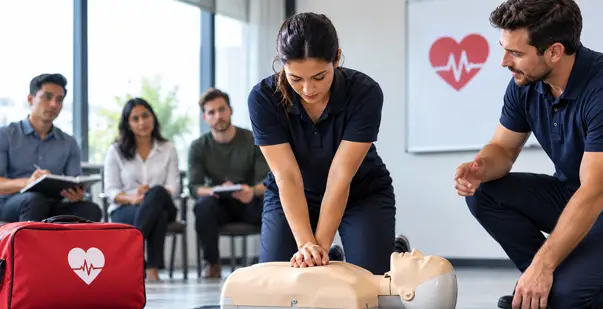
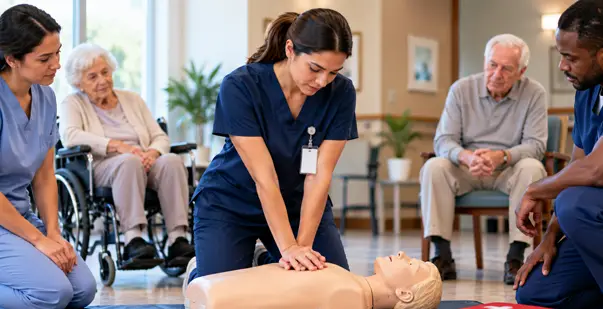
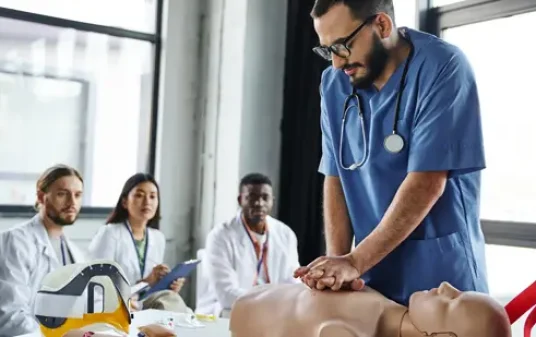
CPR, or Cardiopulmonary Resuscitation, is a lifesaving emergency procedure that’s used if a person’s heart stops beating or they stop breathing. It’s a combination of chest compressions and rescue breaths that help circulate blood and oxygen throughout the body until professional assistance can take over. To administer CPR:
- Check and Call for Help: Check if the individual is aware and if they are breathing. If they are not, call 911 or have someone call them, send for an AED, and start CPR if the person is not breathing normally.
- Start Chest Compressions: Place the heel of one hand on the center of the chest; the other hand on top. Compress ≥2 inches (5 cm) at 100–120/min and allow full recoil.
- Administer Rescue Breaths (if trained): If trained, give 30 compressions, give 2 breaths. Resume compressions immediately after breaths and use an AED as soon as possible.
What is CPR Certification?
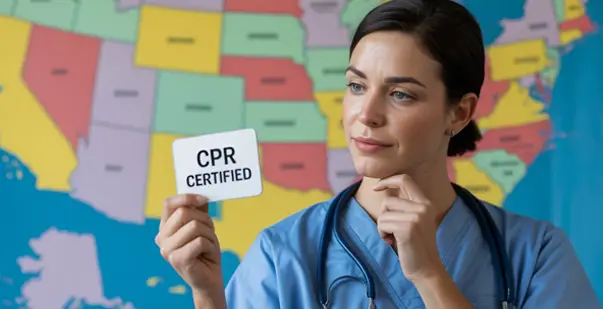
CPR certification for healthcare workers is an official and essential credential that proves you are fully trained and qualified to perform critical, life-saving care during emergencies. The training teaches key CPR techniques, AED (Automated External Defibrillator) usage, and airway management, followed by a skills evaluation to verify proficiency. These courses are provided by nationally accredited organizations such as the American Heart Association (AHA) or the Red Cross. In many healthcare facilities, a valid CPR certification is a prerequisite, which shows your preparedness to provide BLS in crisis situations.
Read More: Why AHA Guideline Updates Matter in Everyday CPR: 2025 Edition
Types of CPR Certifications Available for Medical Professionals
Health care personnel may require different CPR-related certifications according to their job descriptions. The following table lists the most common certifications, their target patient groups, and course validity duration:
| Certification | Who It’s For | Covers | Validity |
| BLS (Basic Life Support) | Nurses, doctors, paramedics, EMTs, therapists, etc. | High-quality CPR Rescue breathing AED use for adults/children/infants Airway obstruction relief | 2 years |
| ACLS (Advanced Cardiac Life Support) | Hospital/EMT professionals in cardiac or ICU care | Advanced CPR Team response to cardiac arrest ECG rhythm recognition IV drugs Airway management | 2 years |
| PALS (Pediatric Advanced Life Support) | Pediatric healthcare providers (pediatricians, peds nurses) | CPR and emergency care for infants/children Respiratory emergencies | 2 years |
| NRP (Neonatal Resuscitation Program) | Obstetric and neonatal staff (NICU nurses, midwives) | Newborn-specific resuscitation: airway/breathing support Emergency protocols for neonates | 2 years |
Benefits of Online CPR Certification for Medical Professionals
The online certification in CPR is also a convenient option among healthcare professionals with hectic schedules. It enables health practitioners to access lifesaving skills anywhere at any time without compromising quality and standards. The advantages of online CPR classes for healthcare providers are:
Flexibility and Convenience
You can learn any time, on any device. Start, pause, and pick up where you left off. Instead of a long classroom day, spread your study across free moments between shifts.
Cost-Effectiveness
Without fees for travel, instructors, or classroom space, online courses are often cheaper. Many providers bundle content into lower-cost packages. Lower expenses mean both hospitals and individuals save money on recurring training.
Interactive, Multimedia Instruction
Successful online CPR courses use videos, animations, and interactive quizzes to engage students. You can redo practice quizzes and demos at your own pace and thus remember better.
Current, Standardized Content
These online courses follow the newest AHA/ILCOR updates. Everyone sees the same standardized lessons, so there is no instructor-by-instructor difference.
Fast Certification and Tracking
After passing the exam, you often get immediate proof of completion. Many sites let you instantly download a digital wallet card or certificate. These records are easily stored, emailed to employers, or uploaded to credentialing systems, streamlining compliance and documentation.
Eligibility and Prerequisites for Online CPR Certification
Most online CPR programs are broadly accessible, but some courses have specific requirements. As shown below, eligibility and CPR requirements for healthcare workers generally depend on the course type and your job role:
| Certification | Prerequisites |
| Basic CPR/AED (Heartsaver) | No prerequisites beyond enrollment and completion Designed for lay rescuers and staff needing basic CPR. |
| BLS (Healthcare Provider) | Typically no formal prerequisites; just register and complete the course. Certification valid for 2 years. |
| ACLS | Current BLS certification required. Courses are for those who already know basic CPR and have some clinical experience. |
| PALS | Current BLS certification recommended/required. Intended for providers of pediatric care (training covers infants and children). |
| NRP | A healthcare license or previous NRP is often required. Often requires having or obtaining BLS and/or PALS. |
Note:
- “Prerequisites” shows typical requirements. Always check your specific provider’s guidelines.
- Most CPR/AED courses accept learners as young as 12-13, BLS requires participants to be at least 16, depending on institutional policies.
How to Get CPR Certified Online for Medical Professionals
Getting online CPR certification for healthcare professionals is easy and convenient. In just a few simple steps, you can complete the training and take the exam from the comfort of your home or office:
Step 1: Choosing the Best Course
Choose a nationally accepted provider for the CPR course that suits the requirements of your work. Find out whether it’s BLS, ACLS, or pediatric and whether it follows AHA/ILCOR guidelines.
Step 2: Register and Create an Account
Sign up on the training website and make a learner profile. Ensure you have steady internet and a compatible device for smooth access.
Step 3: Complete the Online Modules
Go through the course content at your own pace. Watch videos, do interactive lessons, revise what you know, and review tough parts.
Step 4: Pass the Final Exam
Take the multiple-choice test after learning. Most courses need about 70% to pass, and you can retake quizzes if required.
Step 5: Get Your Certificate
Once you pass, you will immediately qualify for the official CPR certification. Most programs let you download a digital CPR wallet card or certificate right away.
How Long Does It Take to Complete an Online CPR Certification?
The length of time to complete CPR courses for medical professionals will depend on the type of CPR course. Some basic courses are only a few hours long, whereas advanced certifications, such as ACLS or PALS, may require added time during the training process. The time it takes to complete different types of certifications generally is:
| Course/Certification | Typical Duration |
| Basic CPR/AED (Adult CPR) | 1-2 hours |
| BLS (Healthcare Provider) | 4-5 hours |
| ACLS (Advanced Life Support) | 6-10 hours |
| PALS (Pediatric Advanced Life) | 10-12 hours |
| Recertification Courses | 2-3 hours |
Note: The duration refers to the total length of the course materials, videos, and quizzes, not how long you personally must take. You can learn at your own pace and finish faster or slower, depending on your schedule and comfort level.
Recertification or Renewal Requirements for Medical Professionals
Most CPR/BLS/ACLS/PALS certifications expire in two years. You must recertify before expiration to stay compliant with hospital or licensing requirements. To maintain compliance and sharpen critical response skills, the requirements of the CPR for healthcare professionals recertification course are designed to keep them prepared and confident:
- Recertification Courses
Renewal often involves a shorter refresher course (online or blended) focusing on updated guidelines. Some programs allow a fully online renewal (for example, a brief exam-only course) if your previous certification is still valid or has recently lapsed.
- Eligibility for Renewal
To take a recertification course, you generally need a current or very recently expired credential. If your certificate has lapsed for too long (often beyond a 30-day grace period), you may need to retake the full initial course instead of a quick renewal.
- Hands-on Practice
Certain roles or state boards may still require an in-person skills check at renewal. Check your employer’s policy. Some healthcare facilities mandate a live component even if the theory is online.
- Documentation
Upon renewal, you receive a new certification card (often digital) extending your qualification for another two years. Many systems will remind you when it’s time to recertify to avoid any lapse in credentials.
Read More: Make BLS Renewal an Easy Process
Cost of Online CPR Certification For Medical Workers
Each CPR certification has its own cost, and there are lots of variables that will impact that cost, such as the course type, provider. Many times, the employer will reimburse the cost of training, making it more affordable and accessible for healthcare professionals.
| Type of Online CPR Certification | Average Cost (USD) |
| Basic CPR/AED | $14.95 |
| BLS (Basic Life Support) | $36.95 |
| CPR Renewal/Recertification | $14.95 |
Technological Features in Online CPR Courses
Modern online CPR programs leverage technology to improve learning and convenience. The table below highlights common features and how they help medical professionals train effectively:
| Features | Notes |
| Interactive Multimedia | Includes instructional videos, animations, and virtual simulations. These engaging materials accommodate different learning styles and make complex skills easier to understand. Quizzes reinforce key steps in real time. |
| Flexible, Multi-Device Access | Coursework is done on computers, tablets, or smartphones. Learners can log in anytime, anywhere. You only need “internet access and a laptop, desktop, tablet or smartphone” to take the course. |
| Self-paced Modules | Content is divided into short modules that you can complete in any order. You have unlimited two-year access to materials, so you can pause between shifts and review sections as needed. |
| Adaptive Learning | Some programs provide an adaptive learning experience with additional practice on weak content areas. This helps with increasing confidence and retention. |
| Immediate Assessment & Certification | There may be built-in quizzes, as well as final exams throughout the course to get immediate feedback. Once passing the course, most often, a digital certificate is awarded to the learner right away. |
All three of these features use technologies to offer a more efficient and effective CPR training to busy medical professionals.
Common Myths and Misconceptions About Online CPR Courses
There are myths about taking CPR for medical professionals online, but most are not true. Online CPR courses are modern, credible, and meet the same rigorous standards as in-person training, but common myths still cause many to doubt their value. Let’s debunk them one by one:
Myth 1: Online CPR Certificates Aren’t Legitimate.
Fact: Credible online CPR programs follow official guidelines. When a provider aligns its courses with AHA/ILCOR standards, employers usually accept the certification. Many state boards and hospitals recognize online CPR if it meets their rules.
Myth 2: You Need Hands-On Practice, So Online Courses Don’t Count.
Fact: Online CPR courses cover the same core knowledge as classroom courses and often require a separate skills session. While some employers (especially for ACLS/PALS) may require a live skill check, the online portion delivers all the theoretical training.
Myth 3: Hospitals Won’t Accept An Online Certification.
Fact: Most healthcare employers do accept properly accredited online CPR certification. For example, one training provider reports that 99% of employers accept its online CPR course completions. Still, always verify your facility’s policy, but don’t assume online means “not valid.”
Myth 4: Online Certifications are Outdated.
Fact: Reputable online courses update quickly. Providers follow the latest AHA guidelines, so online content is refreshed as science evolves. In fact, learners can often see updates immediately when guidelines change.
Choose the Right CPR Certification for Medical Emergencies!
Online CPR for medical professionals is an efficient and flexible way to stay prepared for emergencies. Clinicians gain essential life-saving skills and fulfill job requirements by completing accredited courses (for example, BLS, ACLS, PALS, etc.). Digital courses use interactive content and allow self-paced study, often reducing costs and scheduling hassles. Keep in mind, however, that all standard certifications (even online) generally expire after two years, so timely recertification is crucial. With reputable online providers, the certificates earned are recognized by most employers and licensing boards. Don’t wait for an emergency and stay prepared to act. Enroll in CPR Training today and be ready to save a life tomorrow!
FAQs
1. How frequently must medical professionals renew their CPR certification?
Most CPR certifications stay valid for two years. When it expires, just take a recertification course from an accredited provider to keep your skills and your compliance up to date.
2. Do hospitals and healthcare employers accept CPR certifications from an online course?
Most hospitals and clinics will accept online CPR if it comes from a nationally recognized provider that follows AHA/ILCOR standards. Before you sign up, confirm with your employer that they recognize the course.
3. What is the difference between BLS and ACLS certification for medical professionals?
BLS teaches basic CPR skills for adults, children, and infants. ACLS builds on BLS. You handle cardiac emergencies, read ECGs, and give emergency medications. Hospitals usually require ACLS for doctors, nurses, and emergency medical providers.