




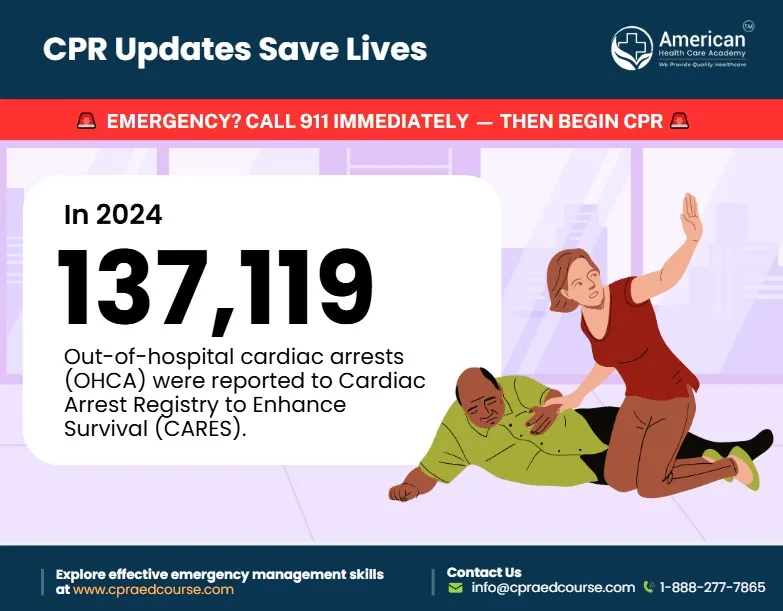
Did you know, out-of-hospital cardiac arrest (OHCA) has a 90% fatality rate, as per the American Heart Association (AHA).
To battle this health crisis, every five years, the AHA updates their guidelines for Cardiopulmonary Resuscitation (CPR) and Emergency Cardiovascular Care (ECC). These updates infuse latest scientific evidence with ongoing practices to improve everyday CPR. This blog explains the impact of AHA CPR guidelines 2025 on first responders, lay rescuers, CPR instructors, and healthcare teams.
What Are the Changes in AHA CPR Guidelines 2025?
The American Heart Association’s 2025 CPR and ECC guideline update introduces various significant changes to enhance techniques, enhance patient outcomes, and respond to changing emergency trends — most notably in pediatric emergencies and opioid emergencies.
Here’s a rundown of the most notable updates:
1. Focus on Emergency-Specific Rescue Breaths
Although high-quality chest compressions continue to be the mainstay of adult CPR, this 2025 update puts extra focus on rescue breaths being given on time by trained rescuers — particularly in non-cardiac-origin arrests like:
- Drowning
- Opioid overdose
- Respiratory-related cardiac arrests
Why it’s important: In these cases, lack of oxygen is the main issue — and chest compressions alone might not be sufficient. This update reminds trained rescuers when breaths are needed, not as an option.
2. New Compression Depth for Children
The AHA now suggests a more accurate chest compression depth for children:
- One-third the anterior-posterior (front-to-back) chest diameter
- Not to exceed 2.4 inches (6 cm)
Why it matters: This method assists in achieving effective compressions with less risk of injury, as physical size can be highly variable among pediatric patients.
3. Revised Infant CPR Technique for Solo Rescuers
For solitary rescuers doing infant CPR, the AHA now advises:
- Two-finger compressions rather than the thumbs-encircling method
- The encircling-thumbs method is also recommended for two-rescuer situations
Why it matters: This modification makes solo rescuer CPR easier to perform and promotes proper hand positioning, enhancing consistency and effectiveness in high-pressure situations.
4. Use of an AED in Infants: More Flexibility
In a significant change, the AHA now recommends more timely use of AEDs in infants younger than 1 year, specifically when pediatric pads or pediatric-capable devices are in use.
Why it matters: Technology has enhanced safety and precision for younger patients. This revision opens up more access to early defibrillation in urgent situations, even infant emergencies.
Why it matters: These revisions create a more comprehensive response protocol for both lay rescuers and professionals, particularly in communities experiencing high cardiac arrest related to opioids.
Why Does the New AHA Guideline Update Matter?
Every five years, AHA updates and reaffirms its CPR and ECC guidelines based on new clinical studies, real-world evidence, and worldwide consensus on what works to save the most lives.
The 2025 update is important because it represents the newest science on how to best respond to cardiac arrest, both in and out of the hospital environment. For healthcare providers, educators, and trained lay responders, older methods may no longer be congruent with evidence-based outcomes.
Whether fine-tuning chest compression rates, revising post-arrest care plans, or reaffirming rescue breaths in special situations such as drowning, each revision is focused on enhancing survival and neurologic outcomes.
Above all, these revisions keep you assured and competent in emergencies where time is of the essence.
Hands-Only vs. Traditional CPR: When to Utilize Each
Knowing which kind of CPR to perform can be life-saving. The AHA identifies two main types of CPR, each with its own application:
Hands-Only CPR (Compressions Only)
When to apply:
For teens and adults who unexpectedly fall down, particularly if you see it happen.
Why it works:
Cardiac arrests with cardiac causes usually leave sufficient oxygen in the body to support organs for a while — provided chest compressions continue to circulate blood.
Best for:
Untrained responders, busy public areas, or circumstances where rescue breaths are not possible.
Traditional CPR (Compressions + Rescue Breaths)
When to apply:
In infants, children, and drowning, drug overdose, or prolonged arrest victims, where lack of oxygen is a major cause.
Why it is effective:
These situations tend to include respiratory failure initially, so oxygenation through rescue breaths is critical to survival.
Best for:
Trained responders and medical personnel.
Being able to recognize when to transition from hands-only to full CPR provides the appropriate intervention at the appropriate time.
Fundamental CPR Skills: Compressions & AED (Step-by-Step)
Despite new science, the fundamentals are still strong. Here’s a simplified, guideline-compliant look at the essential steps in adult CPR:
1. Check for Responsiveness & Call 911
Tap and yell. If unresponsive and not breathing (or just gasping), call 911 and have someone retrieve an AED.
2. Begin Chest Compressions Right Away
- Put your hands in the middle of the breastbone.
- Compress 100–120 beats per minute.
- Push 2 to 2.4 inches (5–6 cm) deep.
- Permit full recoil of the chest between compressions.
3. Use an AED as Soon as Available
- Turn it on, put on pads, and listen to voice instructions.
- Deliver a shock if instructed, and then continue CPR.
4. Continue CPR
- Alternate compressions and rescue breaths (30:2) if trained and needed.
- Continue until EMS arrives or the individual exhibits signs of recovery.
Remember, high-quality CPR and early defibrillation are the most effective things a bystander can do.
CPR for Kids & Infants: What’s Different?
Kids aren’t little adults, and CPR for kids is age-adjusted. Here’s a handy quick-reference chart:
| Age Group | Compression Depth | Compression Rate | Rescue Breaths Required? |
| Infants (<1 yr) | About 1.5 inches (4 cm) | 100–120/min | Yes — 30:2 or 15:2 (2 rescuers) |
| Children (1–12 yrs) | About 2 inches (5 cm) | 100–120/min | Yes — 30:2 or 15:2 (2 rescuers) |
Other Important Differences:
- Use two-finger infant compressions; one or two hands for kids based on size.
- Rescue breaths are always indicated in pediatric CPR since cardiac arrests are usually caused by respiratory problems.
- Use an AED pad specifically designed for children if available; otherwise, adult pads may be used with caution.
Knowing these distinctions guarantees your intervention is both age-specific and guideline-conformant, particularly important for caregivers, educators, and pediatric health professionals.
Staying Prepared Starts with Staying Current
CPR guidelines are designed to improve cardiac emergency response. From compression depth to post-arrest care, every AHA update is a reflection of real-world evidence and evolving best practices. The upcoming AHA guideline updates in 2025 changes are no exception.
Recertifying after a major guideline update is not merely a compliance requirement — it is a critical step in ensuring that your response is informed by the most current clinical standards, backed by the latest evidence. In time-sensitive emergencies, the difference between outdated practice and updated knowledge can directly impact outcomes.
At American HealthCare Academy, we’re ready to help you do just that — with online CPR training aligned to the latest AHA guidelines the moment they launch.
Frequently Asked Questions
1. When are the AHA CPR guidelines scheduled to be released in 2025?
The AHA guideline updates for 2025 will be rolled out on 22nd October.
2. What are the AHA Guidelines for CPR?
The AHA guidelines for CPR incorporate the latest standards for compression depth and rate, rescue breathing, defibrillation, and post-cardiac arrest care. These guidelines enhance survival and neurological recovery in cases of cardiac arrests.
3. How often does the AHA update CPR guidelines?
The AHA officially publishes guideline updates every five years, and the most recent significant update occurred in 2020 and is to be followed by one in October 2025.
4. Why would recertification be necessary after a guideline update?
Recertification keeps your CPR skills and knowledge current with the most recent science. Methods or medications that were once routine might not be current anymore. Staying current enhances both your confidence and the likelihood of survival in actual emergencies.
5. Does my current CPR certification remain valid after 2025?
Your certification will be valid until the date of expiration. Nevertheless, numerous employers and licensing agencies will start demanding the new version within 6–12 months of new guidelines being published. It is best to recertify early in order to remain in compliance and ready.
6. How can I ensure my certificate is current with the new 2025 AHA guidelines?
We at American HealthCare Academy tie all CPR, BLS, ACLS, and PALS courses to the latest AHA guidelines, including the soon-to-be-released 2025 version.
Note: This content is an educational interpretation, not official AHA guidance.