


Bing Ads
Home » Healthcare CPR/AED Course » Infant CPR
Healthcare-cpraed-course-img-eng
Healthcare cpr-aed-mob-img

Online CPR/AED Course

Get certified in Adult, Child, and Infant CPR with our Online CPR/AED Course—built to give you the confidence to act fast in a real emergency. Complete the course at your own pace and receive a 2-year certification, perfect for anyone looking to be prepared in case of a cardiac or breathing emergency.

(111,773 reviews with 4.8 stars)

$14.95 $24.90

Chapters CE Credits Validity Cost Duration ECC Exam Attempts Wallet Card
13 4.0 2 Years $14.95 1-2 Hrs Compliant Unlimited Download/Print/Mail
  • Chapters13
  • CE Credits4.0
  • Validity2 Years
  • Cost$14.95
  • Duration1-2 Hrs
  • ECCCompliant
  • Exam AttemptsUnlimited
  • Wallet CardDownload/Print/Mail

Select Course

Chapter 9: Infant CPR

In infants, cardiac arrest almost always starts with a breathing issue. That’s why, during Infant Cardiopulmonary Resuscitation (CPR), giving breaths alongside compressions is absolutely essential.

The general approach is the same as what you learned for children—but there are a few important differences.

  1. Chest Compressions

For infants, you’ll use a gentler, more precise technique:

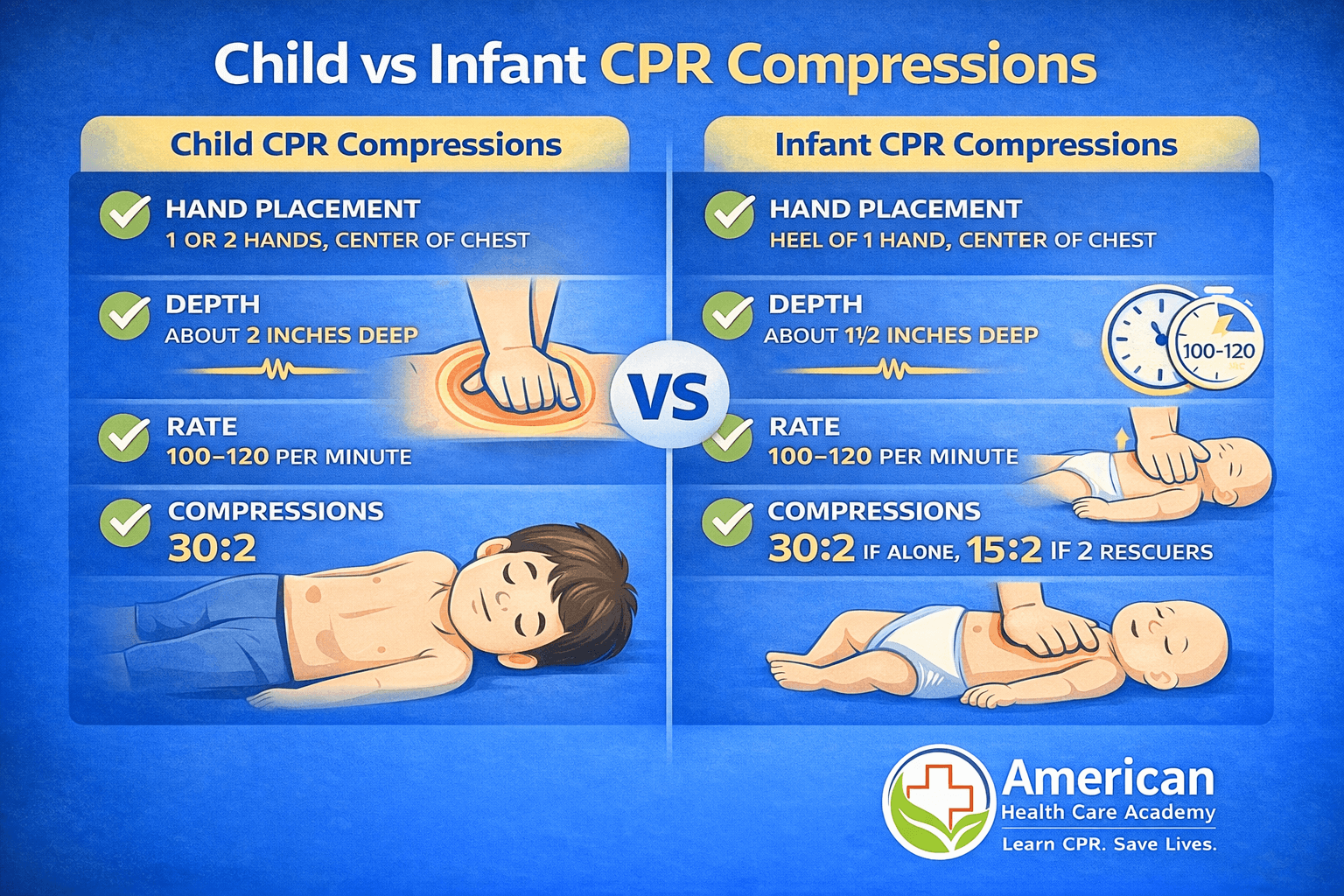
  • Place two fingers in the center of the chest, right between the nipples.
  • Push straight down about 1½ inches, quickly and firmly.
  • Aim for a rhythm of 100 to 120 compressions per minute.
  • Let the chest fully return to its normal position before starting the next compression.

online-cpr-course-infant

  1. Opening the Airway
Be especially careful when tilting an infant’s head to open the airway.
  • Don’t tilt too far back—it can actually close the airway instead of opening it.
  • Use a gentle head-tilt and chin-lift, keeping the position neutral.

online-infant-cpr-course

  1. Giving Breaths

Here’s how to safely deliver rescue breaths to an infant:

  • Cover the infant’s mouth and nose with your own mouth.
  • If that’s not possible, just cover the nose and make sure the mouth stays closed so no air escapes.
  • Give 2 soft breaths, each lasting about 1 second.
  • Watch for the chest to rise with each breath. If it doesn’t, reposition and try again.

This chapter is part of your CPR Certification and prepares you to act quickly and confidently in infant emergencies.