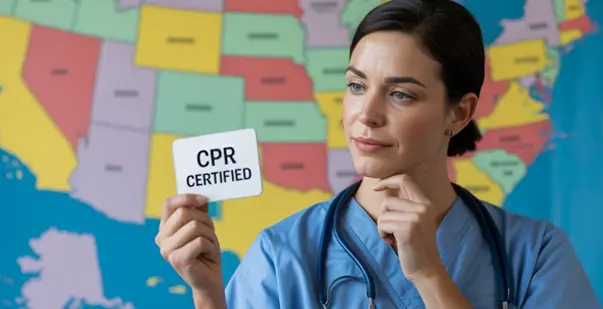





A nurse submits a $19.99 CPR card for a hospital job, and HR rejects it. Not because of the price, but because it certifies layperson CPR, not the BLS Provider training hospitals require. This mix-up is more common than people realise, especially with cheaper CPR courses that skip key clinical skills. In healthcare, “CPR” isn’t one universal certification; the level you need depends on your role, your scope of practice, and your hospital’s policy. Low-cost courses can work for non-clinical staff, but they can fail you instantly if you are applying for a medical position. Let’s break down when budget CPR is acceptable, when it isn’t, and how to confirm what your employer actually expects.
Lay Rescuer CPR vs. BLS Provider: An Overview
Layperson CPR teaches you basic skills for home or community emergencies. You learn single-rescuer chest compressions, rescue breaths, and AED steps. These courses target parents, teachers, coaches, and community members. You don’t practice team coordination or advanced airway devices.
BLS Provider courses prepare you for clinical environments. You practice adult, child, and infant CPR with two-rescuer scenarios. You learn bag-mask ventilation, choking relief, and effective team communication. The AHA’s BLS Provider course also includes training on automated external defibrillators and high-quality CPR performance metrics.
What Makes a CPR Course “Valid” for Healthcare Providers?
Lay rescuer CPR teaches simple, bystander-level skills. BLS Provider training covers adult, child, and infant CPR, two-rescuer response, ventilations, pulse checks, AED use in clinical settings, and team dynamics. A low-cost layperson card may teach basic CPR, but it does not meet these clinical competencies. Here’s why the gap between low-cost BLS vs lay rescuer CPR exists.
Hospital Codes Require Team Coordination Skills
Healthcare employers need proof that you have been trained to function within a clinical team. Lay rescuer courses don’t teach you to coordinate compressions while someone manages the airway. You don’t practice calling out role assignments during codes or transitioning when the crash cart arrives. BLS provider courses drill these multi-rescuer scenarios because you never resuscitate alone in hospitals.
Clinical Equipment Differs from Community Settings
A lay rescuer course focuses on basic scenarios like using AEDs in public settings such as shopping malls and applying simple pocket masks for rescue breaths. Clinical settings use bag-valve masks, oxygen delivery systems, and advanced airways. BLS provider training teaches you to deliver ventilations with supplemental oxygen, use different mask sizes, and operate equipment on hospital crash carts.
Hospitals Follow Strict Accreditation Standards
Hospital policies align with Joint Commission standards, which mandate BLS Provider certification for clinical staff to ensure coordinated emergency response. Your card must state “BLS Provider” or “Healthcare Provider.” If it says “CPR/AED” or “Heartsaver,” it won’t meet compliance requirements. HR systems flag these discrepancies during onboarding and renewal audits.
Insurance and Liability Concerns
Healthcare facilities face legal liability during emergency responses. If an unqualified staff member responds to a code, the facility could face lawsuits. BLS Provider certification demonstrates you have the skills courts expect from healthcare professionals. This legal protection drives strict card verification policies.
Here’s a quick overview of Lay Rescuer CPR vs. BLS Provider
| Feature | Lay Rescuer CPR | BLS Provider |
| Target Audience | Parents, teachers, coaches, community members | Nurses, doctors, EMTs, medical assistants, clinical staff |
| Training Duration | 2-3 hours | 4-6 hours |
| Cost Range | $20-$60 | $45-$120 |
| CPR Scenarios | Single-rescuer only | Single and two-rescuer scenarios |
| Age Groups Covered | Adult and child basics | Adult, child, and infant (detailed) |
| Airway Management | Rescue breaths with a barrier device | Bag-mask ventilation with oxygen |
| Team Dynamics | Not included | Required component |
| Equipment Training | Basic AED and pocket masks | Hospital-grade equipment and crash carts |
| Skills Assessment | Optional or basic | Mandatory hands-on evaluation |
| Documentation Training | Not included | Charting and legal responsibilities |
| Renewal Cycle | 2 years (flexible) | 2 years (strict enforcement) |
| Hospital Acceptance | Non-clinical roles only | Required for all clinical positions |
| Regulatory Compliance | Community standard | Joint Commission and state board compliant |
When Is a Low-Cost CPR Course Acceptable?
Price alone doesn’t invalidate a course. But you need to match the course type to your role. Cheap CPR courses work for non-clinical staff (receptionists, maintenance, fitness trainers). Healthcare professionals (nurses, EMTs, respiratory therapists, physicians) must have BLS Provider certification. State boards and hospitals require it for licensure and credentialing.
Disclaimer: Never choose a course based solely on low price. Non-accredited courses, even cheap ones, won’t be accepted by employers. Always verify the provider is authorized by AHA or Red Cross before enrolling.
Here are some positions where CPR courses work and when they don’t
| Budget Layperson CPR Works | BLS Provider Required |
| Office staff and receptionists | Registered nurses (RN, LPN) |
| Administrative workers | EMTs and paramedics |
| Teachers and coaches | Medical assistants |
| Childcare workers | Respiratory therapists |
| Fitness trainers at gyms | Physicians and physician assistants |
| Community volunteers | Dental hygienists and assistants |
| Restaurant staff | Pharmacy technicians in hospitals |
| Retail employees | Surgical technologists |
| Security guards (non-hospital) | Radiology technicians |
| Home health aides (non-clinical) | Phlebotomists |
| Camp counselors | Physical therapists |
| Lifeguards (check certification) | Occupational therapists |
| Parent or caregiver | Nursing and medical students |
| Office managers in non-clinical settings | Clinical laboratory technicians |
| Hotel and hospitality staff | Anesthesia technicians |
What Does a True BLS Provider Course Include?
A complete BLS Provider course equips you with the critical skills needed to respond effectively in life-threatening emergencies. The curriculum covers these essential topics:
Adult CPR: Compressions and Ventilations
You learn to push hard and fast with 100 to 120 compressions per minute. Compression depth reaches at least two inches for adults. You practice 30 compressions followed by two rescue breaths. You’ll also learn when to use hands-only CPR in specific situations.
Infant and Child CPR Techniques
Pediatric CPR uses different hand positions and compression depths. For infants, you use two fingers. For children, you use one or two hands depending on the child’s size. The compression-to-breath ratio changes in two-rescuer scenarios: 15 compressions to two breaths.
Two-Rescuer Scenarios and Role Switching
Hospital codes involve multiple providers. You practice switching roles every two minutes to prevent fatigue. One person compresses while the other manages the airway. Clear communication—like calling out “switch” ensures smooth transitions and continuous chest compressions.
Bag-Mask Ventilation and Airway Management
You learn to use a bag-mask device to deliver breaths. Proper seal and adequate chest rise indicate effective ventilation. Studies show that improper bag-mask technique can lead to gastric insufflation and reduced ventilation effectiveness. You’ll practice coordinating ventilations with compressions during team resuscitation.
Team Dynamics and Effective Communication
BLS Provider courses emphasize closed-loop communication. You repeat instructions to confirm understanding. You assign roles clearly: compressor, ventilator, AED operator, and team leader. Effective teams reduce errors and improve patient outcomes during high-stress emergencies.
Do Low-Cost Courses Include Skills Assessments?
BLS Provider certification involves more than watching videos. The AHA-accredited course requires hands-on skills evaluation for all BLS provider courses to ensure candidates can perform high-quality CPR.
Here’s what you can expect in the BLS skill assessment:
- You complete online coursework at home
- You schedule a local skills session at a training center, fire station, or community venue
- An AHA-certified instructor evaluates you in person
- You demonstrate CPR, rescue breaths, and proper AED use
- The instructor evaluates your compression depth, rate, and hand placement
- The instructor signs your card after the assessment
- The skills check takes 30 to 60 minutes
Some websites sell “instant certification” with no skills test. You watch a video, take a quiz, and print a card. The AHA does not recognize online-only BLS courses without hands-on skills verification. Hospitals check card validity through verification portals. If your card number doesn’t appear in the database, HR will reject it.
What Documentation Does HR Look For on a CPR/BLS Card?
HR enters your card number into the issuing organization’s portal to confirm authenticity. If the card doesn’t verify or shows an incorrect course type, they’ll reject it. Your BLS provider card must display specific information for verification:
- Your full name exactly as shown on your ID
- Issue date and expiration date
- Course type clearly stated as “BLS Provider” or “BLS for Healthcare Providers.”
- Verification URL or QR code on the back of the card
How Do You Vet a Low-Cost CPR or BLS Course?
You can find affordable BLS training that meets hospital standards by following this checklist to identify legitimate courses:
Check the Guideline Year
The AHA updates guidelines every five years. The current version is the AHA Guidelines 2020, which emphasize high-quality CPR and early defibrillation. Your course should reference these updated protocols.
Verify Identity and Assessment Methods
Legitimate courses require photo ID upload and video proctoring for online exams. The skills portion happens in person with a certified instructor. If there isn’t any in-person skill check, choose another provider.
Confirm the Verification Portal
AHA cards link to the AHA’s database. Red Cross cards link to the Red Cross system. Before you pay, ask for a sample card and verification URL. Test the URL to ensure the portal exists and functions properly.
Watch for False Claims
Some sites claim “AHA-approved” or “AHA-aligned” without authorization. Only AHA Training Centers can issue official AHA BLS Provider cards. The AHA website lists authorized training sites. Don’t trust logos or badge graphics; verify through official channels.
How to Choose: Layperson CPR or BLS Provider?
Now that you know the difference between layperson CPR and BLS certification, the next step is to choose one that aligns with your professional requirements. Use this framework to select the appropriate course for your role.
What Does My Job Description Require?
Read your offer letter or employee handbook. If it states “BLS Provider” or “Healthcare Provider CPR,” you need the full course.
Will I Respond to Medical Emergencies?
Clinical staff who respond to codes need BLS Provider certification. Support staff who only call for help need layperson CPR.
Does My State License Require a BLS Provider?
Check your state board of nursing website. If a BLS Provider is required for licensure, a layperson course won’t satisfy that requirement.
Employer Guide: How to Set Clear CPR Certification Policies
If you hire clinical staff, clear policies prevent confusion. Here’s how you can craft easy-to-understand policies.
Draft Specific Policy Language
State “All clinical staff must hold current BLS Provider certification from an AHA or Red Cross authorized training center.” Specify whether you accept online courses with in-person skills sessions and update policies annually.
Create a Vendor Checklist
Ask: Are you authorized? What guideline year do you teach? How do you verify identity and where do skills checks happen? Require sample cards and portal access before approval.
Train HR Staff to Verify Cards
Train HR to access verification portals with step-by-step instructions for AHA, Red Cross, and third-party cards. Reject cards that don’t verify or lack proper course type labeling.
Offer On-Site or Subsidized Training
Partner with local training centers for on-site BLS courses at group rates ($50-$70 per person). You control quality, eliminate verification issues, and staff appreciate the convenience.
How to Verify Your Current Certification?
If you’re holding onto a BLS card from a previous job or training, it’s worth double-checking whether it’s valid. Here’s how to verify your certification status:
Locate the Verification URL
Flip your card over. You should see a website or QR code. Visit that URL and enter your card number or personal details. If the portal confirms your certification, the card is legitimate.
Check the Course Type
Even if the card verifies, confirm it says “BLS Provider” or “Healthcare Provider.” If it says “Heartsaver CPR/AED,” it’s a layperson card. You’ll need to retake a BLS Provider course.
Confirm Expiration Date
BLS cards expire two years from the issue date. If your card expires, you must renew it before returning to work. Some employers allow a grace period, but most enforce strict expiration policies.
Contact the Issuing Organization
If the verification portal doesn’t work or your card lacks a URL, call the organization listed on the card. Ask them to confirm your certification status. If they have no record of you, the card is fraudulent.
Online BLS Certification: Is It Legit?
Online BLS can be legitimate if it includes a proper skills assessment. A legitimate online BLS course includes comprehensive video instruction, interactive scenarios, and a final exam. Here’s what a legitimate online BLS provider course includes:
- Offers a hybrid model combining online learning with in-person skills testing
- Uses AHA-certified or Red Cross-certified instructors for skills evaluation
- Provides comprehensive video instruction and interactive scenarios
- Includes a final online exam before the skills session
- Requires photo ID upload to verify student identity
- Total course duration matches standard BLS requirements (4-6 hours)
- Instructor physically evaluates compression depth, rate, and technique
- Provider is listed as authorized training center on official websites
- Follows current AHA Guidelines 2020 or latest protocols
- Requires skills session completion within 30-60 days of online coursework
How to Choose the Right BLS Provider for Your Budget
You don’t have to overspend to get a valid certification. Here are some tips to help you choose the right BLS provider that fits your budget:
- Check if your hospital/clinic provides a list of approved training vendors. Ask HR which organizations they accept if no list exists
- Search “AHA hybrid BLS near me” or “Red Cross blended learning BLS.” Compare prices, skill session locations, and scheduling flexibility
- Ask about group rates for 5+ colleagues. Check if your employer offers on-site training partnerships
- Verify legitimacy before purchasing low-cost courses. Invest in authorized providers to prevent card rejection
Cheaper CPR vs BLS Courses: Choose Wisely, Certify Confidently!
Layperson CPR works for non-clinical positions; BLS Provider is mandatory for clinical staff. Cheap CPR courses absolutely work for the right situations. But just ensure they match your professional needs. The difference isn’t about price; it’s about content, assessment, and documentation. Before enrolling, verify the provider’s authorization status, check for in-person skills sessions, and confirm the card will include a verification URL. If your role requires a BLS Provider, don’t settle for a cheap layperson course. It will delay your employment and create frustration. Choose a reputable hybrid course that fits your budget and meets professional standards.
Ready to get certified? Enroll in an accredited online BLS course to study at your own pace, pass the exam, and receive your official certification card delivered to your door.
FAQs
1. Can I use a cheaper CPR course for my nursing job?
No. Nursing jobs in the U.S. require an AHA BLS Provider certification, not a low-cost layperson CPR course. Hospitals verify this during hiring, and submitting the wrong card will delay onboarding or lead to rejection.
2. How do I know if my online BLS course is legitimate?
Check that the provider is an AHA or Red Cross authorized training center. Your card should have a verification URL that confirms your certification in an official database.
3. Do all healthcare workers need BLS Provider certification?
Not all. Clinical staff, like nurses, doctors, and therapists, need a BLS Provider. Administrative and support staff often need only layperson CPR. Check your employer’s policy to determine which course type you need.