



The American Heart Association (AHA) is set to release its 2025 Advanced Cardiac Life Support (ACLS) guideline updates, and for healthcare providers, this is big news. Each revision influences how we react to cardiac arrest and work as a team under stress. The updates don’t just tweak the textbook, they reflect the latest science on what actually saves lives.
So, what should ACLS learners expect? Let’s break it down.
AHA 2025 ACLS Updates: Things to Expect
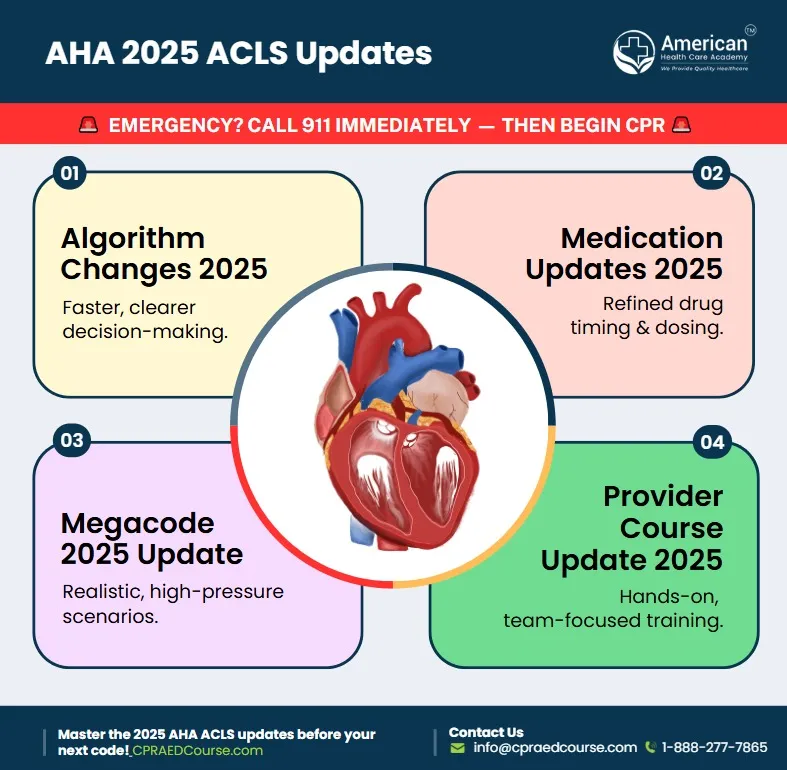
The AHA updates its Cardiopulmonary Resuscitation (CPR) and ECC (Emergency Cardiovascular Care) guidelines every 5 years to match the latest evidence. While the official release is still coming, early insights suggest the AHA ACLS changes 2025 will be directed towards precision, adaptability, and team performance.
Here is what’s likely coming:
1. Smarter Megacode Scenarios
Megacodes are the heart of ACLS training. These are a real-time test of how you manage cardiac arrest as a leader or team member. The ACLS Megacode 2025 updates are expected to make these scenarios more realistic and dynamic.
It is not just about memorizing steps. Learners will need to think, adapt, and make decisions in unpredictable situations. Instructors will assess not just technical accuracy but how well you lead, communicate, and coordinate under pressure.
The shift? From “following the algorithm” to mastering the moment.
2. Refined ACLS Algorithms
Algorithms are the roadmap of ACLS. Expect adjustments based on recent data and performance feedback from real-world cases as per the ACLS algorithm changes 2025. The goal is to make decision-making faster and more effective, especially in complex code situations.
Early discussion points include clearer epinephrine timing, more use of capnography for CPR quality and return of spontaneous circulation (ROSC), and improved care after arrest.
3. Stronger Emphasis on Team Dynamics
If there’s one theme the AHA keeps coming back to, it’s teamwork. Even a perfectly executed algorithm fails if communication breaks down. You might be amazed as nearly half of resuscitation errors stem from poor teamwork and leadership (Bulletin of Emergency and Trauma). The 2025 guidelines are expected to expand on:
- Closed-loop communication: Verbal confirmation of orders and actions.
- Transparency in roles: Everyone knows their responsibility.
- Adaptive leadership: Recognizing when to delegate or take charge.
- Awareness of the situation: Anticipating needs before they’re voiced or expressed.
ACLS is not a solo performance but a coordinated effort. The new focus makes sure that every team member can act confidently and cohesively.
4. Better Integration of Technology
Training tools that give real-time feedback on compression rate, depth, and recoil are becoming essential. The AHA is likely to reinforce its use for both learning and clinical performance.
Why? Because data doesn’t lie. Real-time metrics help learners adjust immediately and develop muscle memory for effective resuscitation.
ACLS 2025 Changes by Algorithm
In the 2025 AHA updates, each algorithm for the primary clinical scenarios, such as cardiac arrest, bradycardia, will likely get sharper, more adaptive, and more feedback-driven. Here is what to expect:
Cardiac Arrest Algorithm
It is emphasized on the timing precision, especially with the use of epinephrine and shock delivery. Real-time feedback devices will become the norm to track compression depth and rate.
Bradycardia Algorithm
The focus is shifting toward earlier intervention and better differentiation between symptomatic and asymptomatic cases. You’ll see clearer thresholds for when to escalate to pacing or pharmacologic management. It will help the clinicians make faster, more confident calls.
Tachycardia Algorithm
Expect tighter integration between rhythm recognition and treatment sequence. Algorithms will likely stress team communication, improving coordination during emergencies. There’s also growing discussion on the use of feedback-guided monitoring during rhythm stabilization.
PEA/Asystole Algorithm
These are still the toughest to manage, but 2025 will gain traction in identifying reversible causes in real time. Think streamlined Hs and Ts, improved use of capnography for monitoring perfusion, and more actionable team prompts.
How Often Does AHA Update ACLS? What to Expect Next
The AHA releases a major update every five years, with focused scientific statements in between if new evidence demands it.
The last two major revisions (2015 and 2020) each introduced major improvements. The 2025 update continues that evolution, shaped by thousands of new studies, clinical trials, and global feedback through the International Liaison Committee on Resuscitation (ILCOR).
For US healthcare professionals, this means your ACLS renewal is more than a formality. It’s a recalibration of life-saving skills at par with the latest science.
What Is the ACLS Update Course?
The ACLS update or renewal course is for certified providers who want to stay updated with the current AHA practices. After the 2025 release, the updated course will most likely include:
- New and revised algorithms and case scenarios.
- Hands-on megacode sessions emphasizing leadership and teamwork.
- Updates on pharmacology, including drug sequence and dosage variations.
- More focus on measures driving care after a cardiac arrest.
You’ll notice more simulation-style training and real-world feedback. It’s not just about passing the test, it’s about preparing for the real thing.
ACLS 2015 vs 2020 vs 2025: What’s Different Now?
Since 1966, the AHA has continuously refined its CPR and ACLS guidelines, turning decades of data, clinical insight, and ethical research into practical, life-saving protocols. Let’s rewind briefly.
| Guideline Year | Key Updates / Focus Areas |
| 2015 Guidelines | – Emphasized compression quality (rate, depth, minimizing interruptions) – Introduced capnography to measure CPR effectiveness – Simplified algorithms for easier recall |
| 2020 Guidelines | – Focused on team dynamics and early recognition of cardiac arrest – Added sections for opioid emergencies and refined post-arrest care – Strengthened the role of continuous high-quality CPR |
| AHA ACLS Guidelines 2025 (Expected) | – Finer control of drug timing (especially epinephrine) – Better-defined rhythm management pathways – More integrated teamwork during megacodes – New emphasis on feedback-driven training – Stronger guidance for in-hospital vs. out-of-hospital ACLS |
Why the 2025 Updates Matter?
Here’s the thing, ACLS isn’t just a certification. It’s your ability to take control when a patient’s heart stops beating. The science of resuscitation evolves constantly. What worked 5 years ago may not be the most effective approach today.
Every change in the guidelines represents thousands of lives studied, outcomes analyzed, and lessons learned. When the AHA adjusts drug sequences or algorithm timing, it’s because those refinements have been proven to improve survival rates and neurological outcomes.
For US healthcare professionals (paramedics, nurses, physicians, and responders), staying current isn’t optional. It’s what defines your readiness and professionalism.
Be Certification-Ready and Compliant!
The 2025 AHA ACLS update is about elevating how we think, communicate, and act during critical moments. This update will focus on:
- Smarter megacode simulations.
- Updated, evidence-based algorithms.
- Deeper focus on team performance.
- Integration of real-time feedback and data.
Are you planning your ACLS renewal or certification soon? Make sure your course reflects the latest standards as soon as they’re released. Stay sharp. Stay updated. Stay ready to save lives.
Learn more about AHA-compliant ACLS, CPR, and First Aid certification courses at CPRAEDCourse.com.
Note: This content is an educational interpretation, not official AHA guidance.