



Bing Ads
Healthcare-first-aid-img-eng
Healthcare-first-aid-and-bloodborne-pathogens-combo-mob-img

Healthcare, First Aid &
Bloodborne Pathogens
Combo

Our all course combo training includes Adult, Child and Infant CPR, First Aid and Bloodborne Pathogens certification. Our Healthcare Provider courses cater to all healthcare professionals. The CPR/AED and First Aid Read More certification is valid for 2 years and the Bloodborne Pathogens certifications is valid for 1 year, per OSHA guidelines. The all course combo includes a free mailed in wallet card. Read Less
(111,773 reviews with 4.8 stars)

$49.95 $59.85

Chapters CE Credits Validity Cost Duration ECC Exam Attempts Wallet Card
32 2 Years $49.95 2 Hrs Compliant Unlimited Download/Print/Mail
  • Chapters32
  • CE Credits
  • Validity2 Years
  • Cost$49.95
  • Duration2 Hrs
  • ECCCompliant
  • Exam AttemptsUnlimited
  • Wallet CardDownload/Print/Mail

Select Course

Chapter 9: Child and Infant CPR

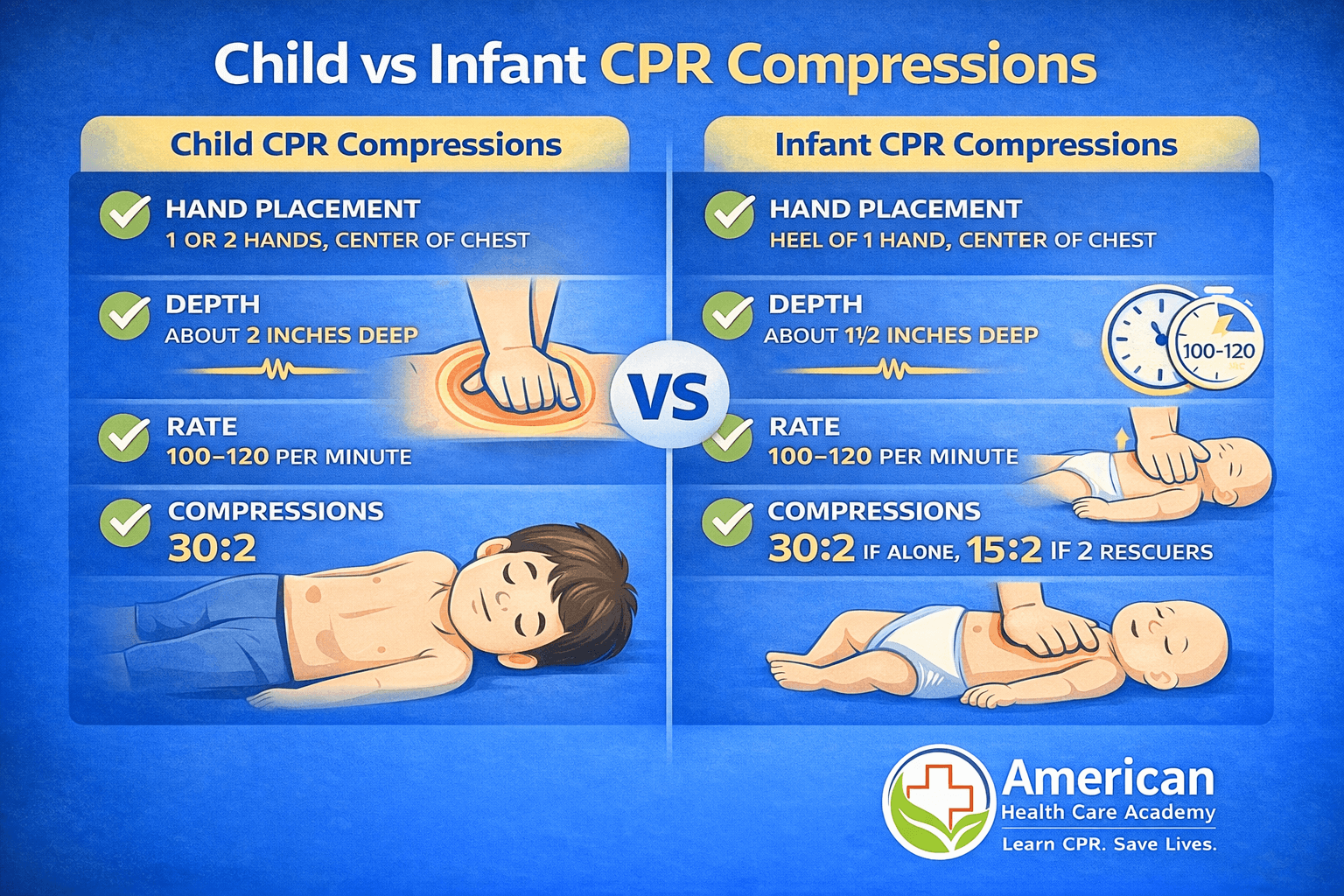
Children and infants often experience cardiac arrest because of breathing problems. Rescue breaths are especially important.

Child CPR

If alone and the collapse was not witnessed:

  • Give 5 cycles of 30 compressions and 2 breaths (about 2 minutes) before leaving to call 9-1-1.

Compressions:

  • Use one hand (or two if needed).
  • Compress at least 2 inches deep (about 1/3 chest depth).
  • Rate: 100–120 per minute.

Airway and breaths are the same as adults.

Infant CPR

Compressions:

  • Use two fingers in the center of the chest just below the nipple line.
  • Compress about 1½ inches (1/3 chest depth).
  • Rate: 100–120 per minute.

Airway:

  • Tilt the head slightly.
  • Do not over-tilt.

Breaths:

  • Cover both the mouth and nose with your mouth.
  • Give gentle breaths.
  • Watch for chest rise.

If alone and collapse was not witnessed:
  • Give 5 cycles before leaving to call 9-1-1.

Child-vs-infant-cpr

Child and Infant 2-Rescuer CPR

When two healthcare providers are present:

  • Use a 15:2 compression-to-ventilation ratio.
  • Compress at least one-third the depth of the chest:
    • Child: about 2 inches (5 cm)
    • Infant: about 1½ inches (4 cm)
  • For infants, use the two-thumb encircling technique when possible.

Switch roles every 2 minutes to maintain high-quality compressions.

Rescuer 2 – Airway and Ventilation

  • Open the airway using the head-tilt, chin-lift (unless spinal injury suspected).
  • Deliver breaths using a bag-mask device.
  • Provide 2 breaths after each compression cycle.
  • Each breath should last about 1 second and produce visible chest rise.
  • Avoid excessive ventilation.
  • Monitor compression quality and prepare the AED.
  • Coordinate compressor switches efficiently to limit pauses.

Using a Bag-Mask Device (BVM)

A bag-mask device is commonly used in healthcare settings to deliver assisted ventilation.

  • Select the correct mask size to create a proper seal over the nose and mouth.
  • Use the E-C clamp technique to hold the mask:
    • “C” forms a seal with a thumb and index finger.
    • “E” lifts the jaw to maintain airway position.
  • Attach the bag to oxygen when available (up to 15 L/min).
  • Squeeze the bag just enough to produce visible chest rise.
  • Deliver each breath over 1 second.
  • If the chest does not rise:
    • Reposition the head.
    • Re-establish the mask seal.
    • Check for visible airway obstruction.

Bag-mask-ventilation-checking

High-quality CPR in a team setting works best when everyone communicates clearly, keeps interruptions short, uses proper ventilation technique, switches roles often to prevent fatigue, and encourages one another to stay strong and focused.