When someone suddenly collapses, stay calm and move step by step.
Check the Scene
Before helping, quickly look around.
Are there dangers such as traffic, fire, exposed electrical wires, or unsafe surroundings? If the scene is not safe, do not approach. Call 9-1-1.
Your safety always comes first.
If available, use personal protective equipment (PPE) such as disposable gloves or a breathing barrier. PPE helps protect you from blood or bodily fluids. However, do not delay life-saving care if PPE is not immediately available.
Avoid direct contact with blood whenever possible and wash your hands after providing care.
Check Responsiveness
Tap the person and shout, “Are you okay?”
For an infant, gently tap the foot.
If the person does not blink, move, speak, or respond, consider them unresponsive.
Shout for help. Point directly to someone and say, “You, call 9-1-1.” Point to another person and say, “You, get the AED.” Designating someone prevents confusion.
If you are alone:
- Call 9-1-1 on speaker if you have a phone.
- If you do not have a phone, leave briefly to call 9-1-1 and return immediately.
Check Breathing
Look at the chest for normal breathing for at least 5 seconds but no more than 10 seconds.
Normal breathing means steady, regular chest rise and fall.
Gasping is not normal breathing. Gasping may:
- Sound like snorting or choking
- Occur only occasionally
- Look like brief, irregular breaths
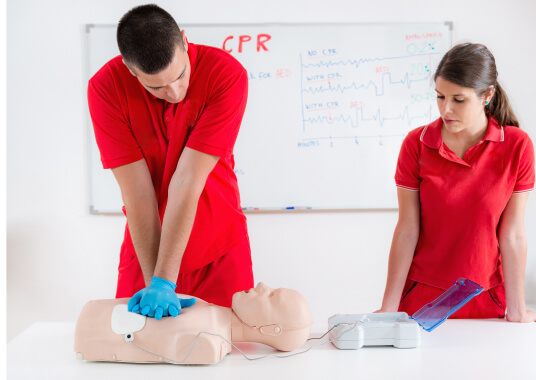
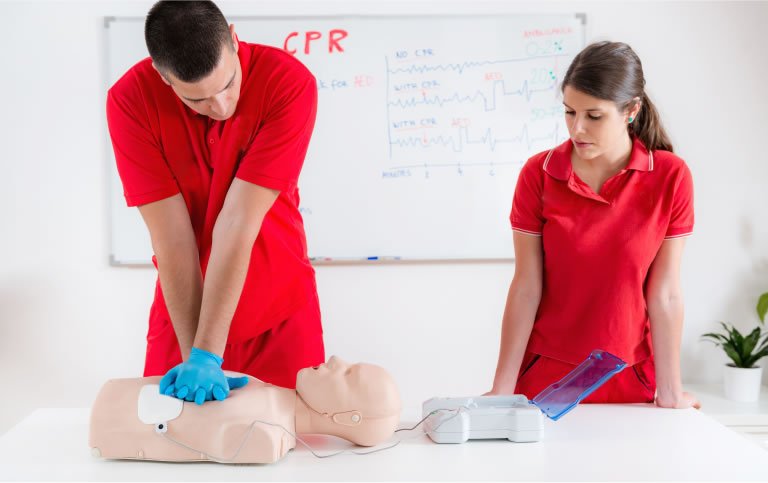
If the person is unresponsive and not breathing normally, begin CPR immediately.
ECC Chain of Survival
Survival from cardiac arrest depends on a sequence of critical actions called the Chain of Survival:
- Early recognition and activation of emergency response (call 9-1-1)
- Early CPR, with an emphasis on chest compressions
- Rapid defibrillation using an AED
- Early advanced medical care
- Integrated post–cardiac arrest care
Each link strengthens the next. Acting quickly improves survival. These steps apply to both adult and pediatric cardiac arrest emergencies.







 (111,773 reviews with 4.8 stars)