Why CPR for Healthcare Providers?
Healthcare providers work in environments where cardiac, respiratory, and circulatory emergencies can occur without warning. CPR training equips them with the skills required to recognize cardiac arrest, initiate high-quality chest compressions, manage airways, and use automated external defibrillators correctly. For a healthcare provider, knowing CPR is not a general safety measure: it is a professional requirement that directly affects whether a patient survives long enough to receive advanced medical care. Current CPR certification is a credentialing requirement for most clinical roles and is required for license renewal in many healthcare professions across the United States.
What does Healthcare Provider mean?
In the context of CPR and emergency response, a healthcare provider refers to anyone working in a professional role where there is a reasonable risk of encountering a medical emergency. This includes physicians, nurses, paramedics, EMTs, respiratory therapists, medical assistants, childcare workers, dental professionals, and fitness instructors, as well as first responders in non-clinical settings such as school nurses and park rangers. If your role involves caring for others or working in an environment where someone could suffer a cardiac or medical emergency, you fall into the healthcare provider category for CPR certification purposes.
What are the benefits of CPR for Healthcare Provider online certification?
Online CPR certification for healthcare providers delivers the same accredited credential as in-person training while eliminating the scheduling constraints and travel time that make traditional recertification difficult for working clinicians. Learners can study at their own pace, replay instructional videos as needed, and sit the certification exam when they are ready. The online format lets you revisit challenging concepts like bag-mask ventilation technique or infant CPR ratios without instructor-paced pressure. Certification is available for immediate download upon passing, and your credential carries the same two-year validity and national acceptance rate as in-person course certifications.
What is the difference between Healthcare Provider CPR and BLS?
CPR and BLS are related but not equivalent credentials. CPR, or cardiopulmonary resuscitation, is the core emergency technique involving chest compressions and rescue breathing to maintain circulation during cardiac or respiratory arrest. BLS, or Basic Life Support, is a broader credential that incorporates CPR alongside AED operation, advanced airway management, and choking response for adults, children, and infants. For most healthcare provider roles, BLS is the expected credential because it covers the full range of basic emergency responses a clinician may need to deliver, with CPR being one component within that broader framework rather than a standalone equivalent.
Why is AED Training for Healthcare Providers Important?
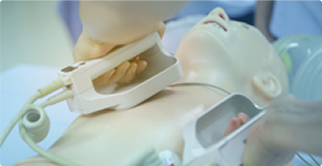
Cardiac arrest is a leading cause of death in the United States, and survival rates decline by approximately 10 percent for every minute that passes without defibrillation. Average emergency response times run 8 to 12 minutes, meaning a patient in a facility without trained staff on site faces very poor odds before EMS arrives. Healthcare providers trained to use an AED can deliver a defibrillating shock within the critical first minutes, which is the single most effective intervention for ventricular fibrillation and pulseless ventricular tachycardia, the two most common shockable rhythms in cardiac arrest.
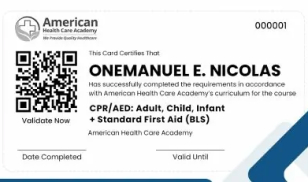
Need CPR AED and First Aid Certification?
Get your own certificate in less than 15 minutes*
Start Now
*This is subject to both Course Completion and Quiz Success.
What healthcare professionals can expect in their CPR certification course?
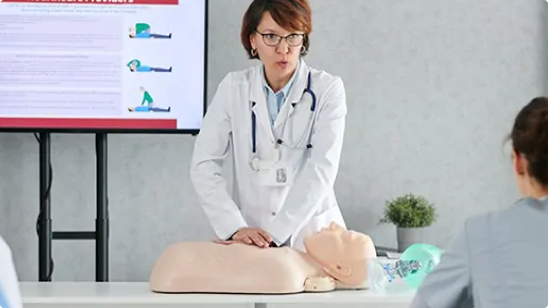
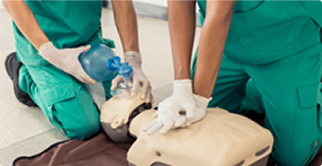
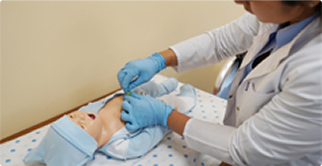
Healthcare professionals can expect comprehensive CPR and AED training covering adults, children, and infants, including correct compression depth, rate, and ratio for each age group. The course covers proper AED operation from pad placement through shock delivery, bag-mask ventilation, and emergency management of choking in adults, children, and infants. The curriculum also addresses recognition of the signs and symptoms of heart attacks, strokes, and cardiac arrest, and the correct response sequence for each scenario according to current AHA/ECC guidelines. All content reflects updated evidence-based practice for clinical and prehospital emergency response.
Who should enroll in this course?
This CPR certification course for healthcare providers is designed for any professional whose role requires documented CPR competency or whose environment involves risk of cardiac or respiratory emergencies. This includes physicians, nurses, paramedics, EMTs, respiratory therapists, medical assistants, dental professionals, childcare workers, school nurses, fitness instructors, and any other clinician or non-clinical healthcare worker whose employer, licensing board, or credentialing organization requires a current CPR certification. If you work in a setting where someone could have a cardiac emergency, this course is the appropriate certification level for your professional role.
Do you offer instant certification?
Yes. After completing the CPR certification course for healthcare providers online and passing the final exam with a score of at least 75 percent, your digital certification is available for immediate download from your account dashboard. There is no processing delay between passing and receiving your certificate. You can print it or forward it digitally to your employer for credentialing verification. A physical wallet card is mailed to your registered address within 5 to 7 business days after you complete payment. Your certification is valid for two years from the date of passing.


















 Google Rating